La collaboration Foobot x Smart Impulse au service de la performance énergétique
Chez Foobot, nous déployons des agents IA capables d'optimiser en continu les systèmes CVC des bâtiments tertiaires ou des établissements de santé. Notre technologie agit comme un expert énergéticien qui connait parfaitement votre batiment. Mais pour que cette IA soit au maximum de ces performances, elle a besoin d'une chose essentielle : des données de consommation fiables et détaillées par usage.
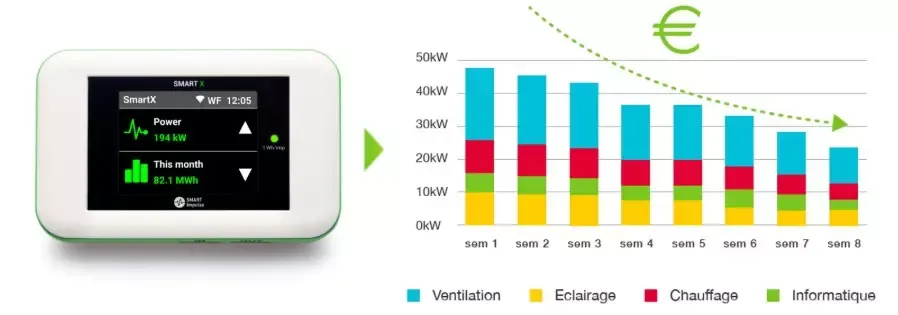
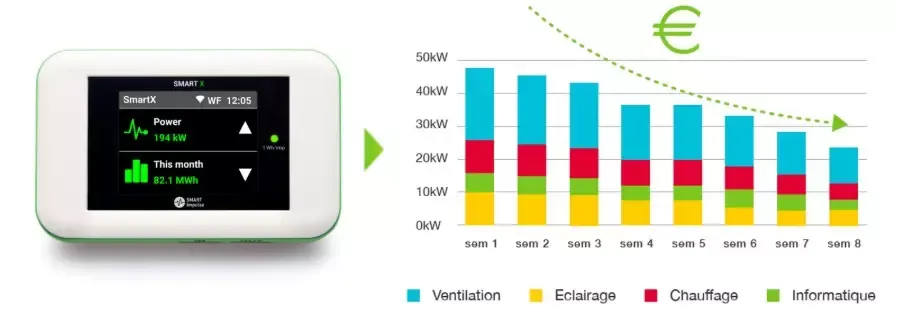
C'est précisément ce que nous apporte Smart Impulse. Leur solution de mesure permet d'obtenir à partir d'un compteur intelligent et d'algorithmes basés sur l'IA, une analyse des consommations d'un bâtiment par usage (éclairage, informatique, chauffage, etc.). Cette granularité de données permet à notre IA de travailler avec une précision inégalée.
1) L'enjeu du pilotage CVC intelligent
Le système CVC représente en moyenne 50 % de la consommation énergétique des bâtiments tertiaires en Europe. Dans un contexte de décret tertiaire et d'obligations BACS, les gestionnaires de patrimoine cherchent des solutions pour réduire cette consommation sans impacter le confort des occupants.
Le problème ? Les systèmes de Gestion Technique du Bâtiment (GTB) existants sont configurés une fois, puis rarement optimisés. Les réglages dérivent, les conditions changent (météo, occupation, usages), et la consommation grimpe silencieusement.
Foobot répond à ce défi avec une approche radicalement différente : notre IA s'entraîne sur un jumeau numérique calibré du bâtiment, puis pilote les paramètres clés de la GTB en temps réel. Elle anticipe, ajuste, et corrige les dérives automatiquement.
2) Smart Impulse : la donnée qui alimente notre IA
Pour entraîner notre IA et mesurer ses performances, nous avons besoin de données énergétiques fiables, en continue et détaillées par usage. Smart Impulse nous apporte exactement cela.
a) Une baseline fiable pour l'apprentissage
Grâce à l'API Smart Impulse, nous récupérons les données de consommation CVC isolées des autres usages. Cela nous permet de construire une situation de référence robuste sur laquelle calibrer notre jumeau numérique et valider nos modèles selon la norme ASHRAE G14.
b) Un reporting transparent des économies
Une fois l'IA déployée, les données Smart Impulse permettent de quantifier précisément les économies réalisées sur le poste CVC, bâtiment par bâtiment, saison par saison. Plus de doute sur "ce qui a vraiment été économisé" : la preuve est dans les données.
3) Notre technologie : Deep Reinforcement Learning et jumeaux numériques
Contrairement aux systèmes de règles statiques ou aux approches MPC de nos concurrents, Foobot utilise le Deep Reinforcement Learning (DRL) - la même technologie qu'AlphaGo de DeepMind. Notre IA s'entraîne dans un environnement virtuel sur l'équivalent de plus de 800 ans de données, développant une capacité d'adaptation aux imprévus unique.
Concrètement, l'IA Foobot optimise :
- les lois d'eau (circuits chaud et froid),
- les lois d'air (centrales de traitement d'air),
- les horaires de démarrage et d'arrêt des équipements,
- ou d'autres paramètres influant sur la consommation.
Point clé : Foobot ne remplace pas la GTB. Il s'y connecte comme une couche intelligente, interopérable et réversible (arrêtable d'un simple bouton).
4) Cas concret : bureaux tertiaires, mesure + pilotage IA
Un exemple représentatif de notre approche concerne des bâtiments de bureaux d'environ 13 000 m², où Smart Impulse et Foobot ont été déployés conjointement.
Le processus :
1. Installation Smart Impulse : plan de comptage rapide, sans coupure, permettant d'isoler précisément la consommation CVC.
2. Création du jumeau numérique Foobot : modélisation du bâtiment, calibration selon ASHRAE G14, entraînement de l'IA.
3. Connexion à la GTB : déploiement de l'IA via API ou passerelle dédiée.
4. Pilotage continu : ajustements toutes les 15 minutes, optimisation en fonction des conditions réelles.
5. Reporting consolidé : suivi des économies par usage grâce aux données Smart Impulse.
Résultats mesurés :
27% d'économies sur le CVC par rapport à l'année de référence 2022, soit 170 MWh économisés et environ 60 000€ de gains - le tout sans dégradation du confort thermique.
5) Un retour sur investissement rapide et une IA frugale
La combinaison Smart Impulse + Foobot offre un retour sur investissement accéléré :
- Foobot : retour sur investissement typique de 12 mois ou moins selon la taille et la configuration du bâtiment.
- Smart Impulse : permet de prioriser les actions dès le départ et d'objectiver les gains tout au long du projet.
Notre IA se distingue également par son bilan carbone exemplaire : 1 tonne de CO₂ émise pour 700 tonnes économisées. Contrairement aux LLM énergivores, le Deep Reinforcement Learning est une technologie frugale, robuste et déterministe.
Conclusion : mesurer mieux pour piloter plus finement
La collaboration Foobot x Smart Impulse illustre une conviction forte : l'IA de pilotage énergétique ne peut exceller que si elle s'appuie sur des données de qualité. En combinant la mesure par usage de Smart Impulse et l'optimisation continue de Foobot, nous offrons aux gestionnaires de patrimoine une solution complète pour :
- Comprendre précisément où part l'énergie
- Optimiser le CVC en continu, sans travaux
- Prouver les économies réalisées
- Maintenir la performance dans la durée
Article rédigé en collaboration avec les équipes de Smart Impulse. Merci à Sabine Dorgan pour sa contribution.
FAQ - Définitions
CVC : qu'est-ce que ça veut dire ?
CVC signifie Chauffage, Ventilation, Climatisation. Ce terme regroupe les systèmes qui assurent le confort thermique et la qualité d'air dans un bâtiment, et c'est souvent un des postes les plus impactant à optimiser en exploitation pour réduire la consommation énergétique d'un bâtiment.
Deep Reinforcement Learning : qu'est-ce que c'est ?
Le Deep Reinforcement Learning (DRL) est une branche de l'intelligence artificielle où un agent apprend à prendre des décisions optimales par essai-erreur dans un environnement simulé. C'est la technologie utilisée par DeepMind pour battre les champions du monde au jeu de Go. Contrairement à l'IA générative (LLM), le DRL est déterministe, fiable et adapté au contrôle industriel.
Jumeau numérique : c'est quoi ?
Un jumeau numérique est une réplique virtuelle du bâtiment qui reproduit fidèlement son comportement thermique et énergétique. Calibré selon la norme ASHRAE G14, il permet d'entraîner l'IA et de prédire les économies réalisables avant tout déploiement.
Décret Tertiaire : rappel
Le Décret Tertiaire (Éco Énergie Tertiaire) impose une réduction progressive de la consommation d'énergie des bâtiments tertiaires de plus de 1000 m² : -40% en 2030, -50% en 2040, -60% en 2050. Les gestionnaires doivent déclarer leurs consommations chaque année sur la plateforme OPERAT.
Retour au blog