Start every system at the best time.
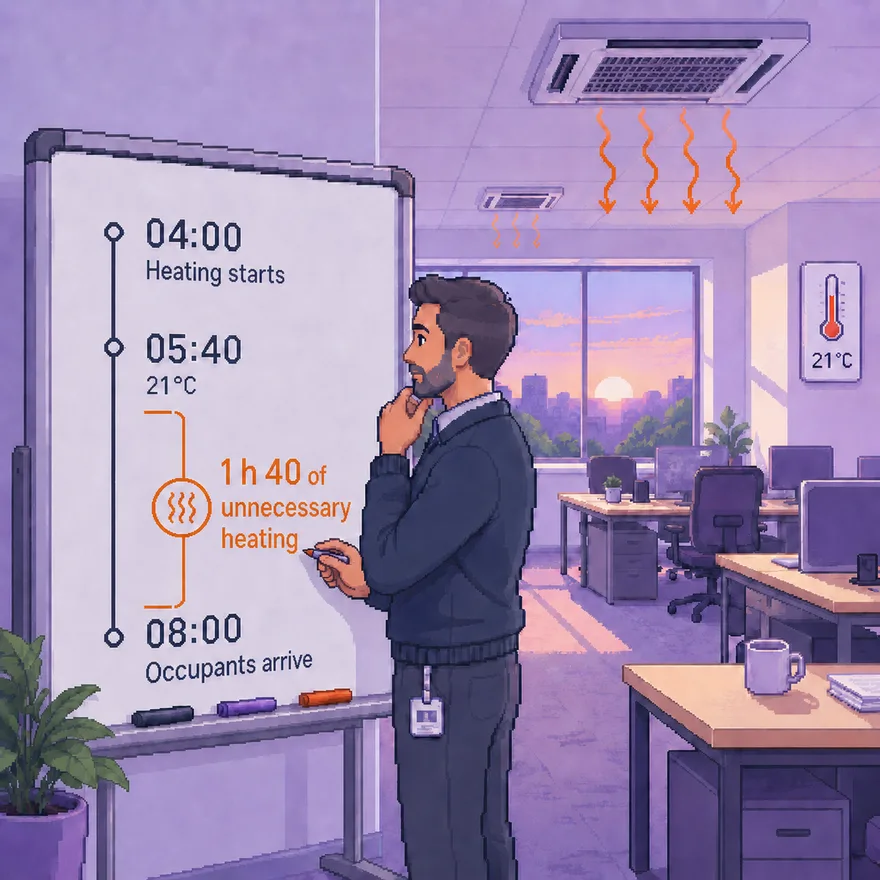
Your time schedules are set “for the coldest day of the year”. Foobot learns the inertia of each zone in the building: start times are written 5 days ahead, zone by zone, then adjusted every day with the weather — comfort reached right at opening, without the wasted pre-heating hours.
A fixed time schedule costs you three times over.
Most BMSs start HVAC on a fixed schedule, set to the worst winter case years ago. The first signal isn't the energy bill: it's comfort complaints and the hours spent retouching schedules.
A building doesn't have one inertia, it has hundreds.

Every zone is a special case.
Orientation, glazing, ceiling height, occupancy, internal gains: two zones on the same floor don't warm up at the same speed. A building-level start applies the coldest zone's setting everywhere: many zones start too early.
Manual tuning doesn't scale.
An operator can fine-tune three zones. They can't tune two hundred. That's the point of automatic computation: not that it tunes better, but that it tunes everywhere, every day, following the weather — something no team can sustain manually.
Optimal start reaches back to production.
A fine zone-level start is useless if the water loop and air handling units have been running since 4 am. We also compute the start time of the equipment feeding those zones, from the start times of the zones they serve. Nothing keeps running for a building that's still empty.
Three steps to start at the best time
Connect the BMS
Secure connection to a few points of your existing BMS. No hardware to change, no operational downtime.
Learn thermal dynamics
The AI models the thermal inertia of each zone from your histories, the weather and occupancy schedules.
Write the schedule 5 days ahead
Foobot writes into the BMS the start times for the five days ahead, zone by zone, and for the corresponding production equipment.
Savings from the very first week.

“Simply by shifting the start time, we cut nearly two hours of heating every morning — without anyone noticing on the comfort side.”
Why begin with optimal start?
It's the fastest and lowest-risk HVAC optimisation gain: a few BMS points are enough, comfort stays guaranteed, and you measure the savings within the first days.
Fast to deploy
Operational in a few days, with no work and no operational interruption.
Improves comfort
No more slow zones taking hours to warm up on Monday morning, thanks to a zone-specific start.
Immediate gain
Runtime hours avoided, measurable from the very first week.
A stepping stone to full control
Optimal start is the first building block. Move on to continuous AI HVAC control next.