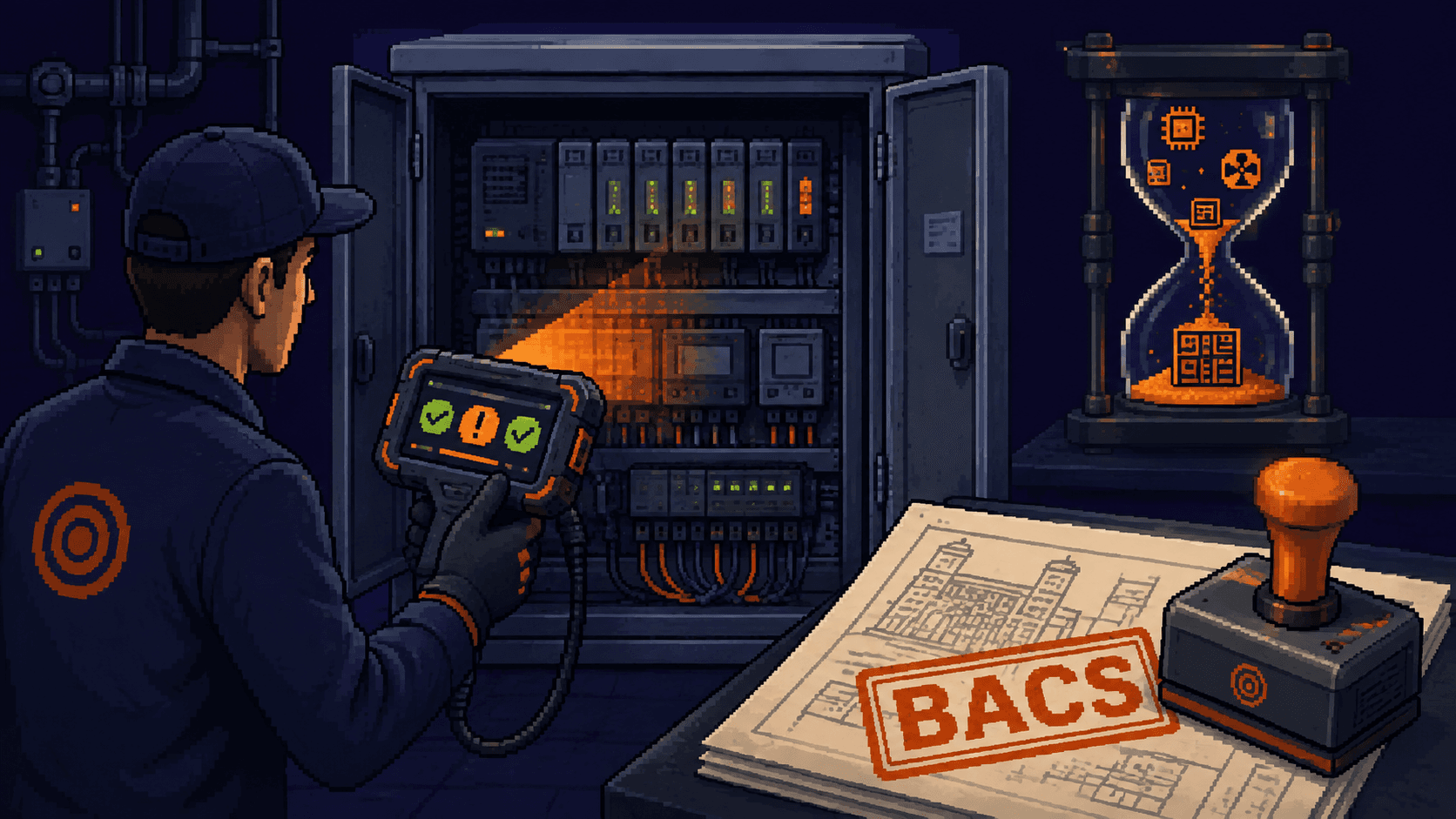
The BACS decree mandates the automation of HVAC systems in non-residential commercial buildings. The obligation has been in force since January 1, 2025 for buildings whose effective rated output exceeds 290 kW. The BMS becomes a regulatory lever as much as an energy one. This guide covers the full scope: deadlines, classification, funding - and compliance as the starting point of real optimization, not the end goal.
BACS decree: definition, regulatory framework and deadlines
Definition and regulatory framework: decree no. 2020-887 of July 20, 2020
The decree no. 2020-887 of July 20, 2020, published in the Journal Officiel on July 21, 2020, transposes into French law the obligation to install a Building Automation and Control System (BACS) in commercial buildings. It creates articles R. 175-1 to R. 175-5-1 of the French building and housing code. The BMS - GTB (Gestion Technique du Bâtiment) in French - is its operational equivalent. This text is the foundation of the regulation in force since July 2020.
The decree applies to every non-residential commercial building equipped with heating, cooling or ventilation systems. It requires a minimum level of automation defined by the NF EN ISO 52120-1:2022 standard, which introduces a classification from A to D. Class B is the minimum compliance threshold for most of the buildings concerned.
Goals of the decree: cutting the energy consumption of the tertiary sector
The BACS decree serves the goals of the French Energy-Climate law: cutting by 40 % the energy consumption of the tertiary sector by 2050 (2010-2022 baseline, source: rt-re-batiment.développement-durable.gouv.fr). This sector is the second largest electricity consumer in France (source: RTE). The targeted energy savings depend on automating the HVAC systems of every building. The energy stakes go beyond mere regulatory compliance.
Commercial buildings consume about 320 TWh per year in France according to Ademe. Automating HVAC systems cuts consumption by 15 to 30 % on average, depending on how mature the building is before deployment (source: REHVA and BPIE studies). The BACS decree therefore creates a real economic lever, beyond its mandatory nature.
Link with the European EPBD directive and the French Tertiary decree
The BACS decree transposes directive 2018/844 (EPBD - Energy Performance of Buildings Directive) into French law. Two complementary texts structure the regulatory framework in the tertiary sector:
- Directive 2018/844 - obligation to automate building HVAC systems
- Tertiary decree - obligation to reduce energy consumption
The two texts are distinct, not redundant. BACS compliance does not exempt you from the Tertiary decree. The Tertiary decree sets reduction targets of 40 % by 2030 and 60 % by 2040 against a reference year. A real estate portfolio manager therefore has to steer BACS compliance and consumption reduction trajectories at the same time.
Scope and concrete obligations of the BACS decree
The effective rated output thresholds: 290 kW and 70 kW
The effective rated output is the sum of the capacities of the HVAC systems installed in the building. Two thresholds determine the BACS obligation:
- 290 kW: mandatory since January 1, 2025 (deadline already passed)
- 70 kW: mandatory by January 1, 2030
Every commercial building above these thresholds falls under the decree (source: decrees no. 2020-887 and no. 2023-259). A prior technical audit establishes the total output precisely and determines which deadline applies.
New and existing buildings: the exact scope of the obligation
The BACS obligation covers all non-residential commercial buildings, new and existing. For new buildings, the obligation applies as soon as the building permit is filed after the decree came into force. For existing buildings, it requires a compliant system to be in place according to the defined schedule. No commercial building above the output thresholds is exempt merely because of its age.
For new buildings, integrating the system at design stage costs significantly less than retrofitting it later. For existing buildings, compliance often requires a phase of wiring and integrating the equipment into the new supervision system.
HVAC equipment concerned: heating, cooling and domestic hot water
The BACS decree covers all heating and cooling equipment connected to the BMS. The systems concerned include:
- Boilers and heat generators
- Chillers and heat pumps
- HVAC: air handling units (AHU)
- Hot/chilled water networks and fan coil units
- Collective domestic hot water systems
Every piece of equipment must be brought into the BACS supervision scope. A system that supervises only part of the building installations does not meet the requirements of the decree.
HVAC control, automation and supervision
The decree distinguishes three operational levels in the HVAC control chain. The first level is the local regulation of each piece of equipment. The second level provides centralized supervision through a BMS-type control system. The third level adds the global optimization of consumption at building scale.
The BACnet and LON protocols integrate the equipment into the supervision layer. To meet the BACS obligation, the system must cover at least the first two levels. The third level, corresponding to class A, is recommended for buildings with high performance stakes.
BMS classification and funding the compliance work
Class D: non-automated building, not compliant with the BACS decree
The NF EN ISO 52120-1:2022 standard defines four BMS performance levels. The table below sums up the four classes:
| Class | Level | BACS decree compliance | Description |
|---|---|---|---|
| Class D | Not automated | Not compliant | No automation system. The starting point for buildings that have not undertaken anything yet. |
| Class C | Standard automatic management | Compliant (minimum threshold) | Basic automatic regulation. The minimum threshold required by the BACS decree. |
| Class B | Advanced automatic management | Compliant | Fine-grained regulation with performance reporting. The level most compliance projects aim for. |
| Class A | Autonomous, optimized management | Compliant (highest level) | Dynamic optimization, adaptation to occupancy conditions. The most advanced level in the standard. |
A class D building will have to climb several technical levels to meet the regulatory obligation. A prior BMS audit establishes the class upgrade trajectory.
Class C: standard automatic management, the minimum compliance threshold
Class C is the minimum compliance threshold of the BACS decree. It means standard automatic management of the HVAC equipment, with basic regulation and centralized supervision. A class C building meets the legal obligation - but without the advanced reporting and optimization features that make a BMS worth more than mere compliance. Autonomous management is not part of the picture at this level.
CEE form BAT-TH-116: funding the installation of a BMS
The CEE form BAT-TH-116 is the standardized operation that funds the installation of a BMS through the French energy savings certificates scheme (CEE). It is open to non-residential commercial buildings carrying out BACS compliance work or a BMS class upgrade. The amount of the CEE premium depends on the building surface, the target BMS class and the reference consumption. The premium is paid by a CEE obligated party (an energy supplier) in return for the completed works.
Expert advice: the CEE BAT-TH-116 premium is conditional on reaching a verifiable target BMS class. A prior audit qualifies the starting class and sizes the project to maximize eligibility. Making the meters reliable beforehand is often decisive to justify the consumption baseline to the CEE obligated party.
Return on investment: calculation and timeline
The return on investment of a BMS installation depends on several factors: installation cost, savings generated, CEE premium received and system lifespan. For a 5,000 m² office building, the average cost of a BMS deployment ranges from 150,000 to 500,000 euros depending on the complexity of the existing installations. The yearly savings generated by a class B BMS sit between 15 and 20 % of HVAC consumption. With Foobot AI Control, that level reaches -30 %, verified under the IPMVP protocol (testimonial from Stéphane Roy, Hachette Livre). The return on investment is markedly faster.
Compliant BMS or optimized BMS: going beyond mere compliance
What BACS compliance does not guarantee
The BACS decree (Building Automation & Control Systems) requires commercial buildings to run automated regulation that keeps air quality within acceptable limits. Without active supervision, pollutant concentrations can exceed the guideline values within a few hours.
In a poorly ventilated office, CO2 can reach 2,500 to 3,500 ppm within 2 hours with 10 occupants. Above 1,000 ppm, cognitive performance drops by 15 %. Above 2,500 ppm, drowsiness and headaches set in.
Released by paints, carpets, furniture and cleaning products, VOCs build up when the air is not renewed. Formaldehyde (a group 1 carcinogen per IARC) can reach 80 µg/m³ in an unventilated new building.
PM2.5 particles reach deep into the lungs. In dense urban areas, outdoor infiltration combined with indoor sources (printers, kitchens) can drive concentrations to 45-60 µg/m³ without active, BACS-driven filtration.
Humidity below 30 % irritates mucous membranes and helps viruses spread. Above 70 %, molds (Aspergillus, Cladosporium) grow on walls within 24 to 48 hours. BACS regulation keeps the comfort range continuously.
Without automated regulation, temperature gaps between zones can reach 6 à 8°C on a single floor. Productivity drops 2 % per degree above 25°C. The BACS decree requires zone-by-zone regulation with presence sensors to optimize energy consumption.
Sources: WHO (2021), ANSES, decree no. 2020-887 on BACS, ADEME, CSTB - French indoor air quality observatory 2023-2024
Reaching BACS compliance is a necessary step. It is not a guarantee of lasting performance. A building fitted with a class B BMS can see its HVAC consumption creep back up in the months after commissioning. This energy drift follows a well-documented pattern in the field: manual overrides piling up, VIP complaints handled in degraded mode, regulation sequences losing traceability.
Contract commitment: 12 months vs 3 to 5 years
The Foobot commitment is 12 months - among the shortest on the market. Traditional BMS solutions lock you in for 3 to 5 years. This is a deliberate stance: clients stay because they are satisfied, not because a contract forces them to. For a real estate department engaging its BACS compliance, this differentiator matters. Regulatory compliance should not become a vehicle for long-term contractual dependency.
How Foobot supports your BACS compliance
Step 1 - BMS audit: diagnose what exists before investing
The Foobot BMS audit builds a complete inventory of the existing estate: identifying the HVAC equipment, calculating the effective rated output, checking the protocols in place (BACnet, LON), analyzing consumption history and detecting malfunctions. This audit is the foundation of the compliance plan and identifies any applicable exemptions. It produces a documented report usable for CEE and EPC filings.
Step 2 - Qualifying the target BMS class
Based on the audit, Foobot qualifies the target BMS class under the NF EN ISO 52120-1:2022 standard, combining the requirements of the BACS decree with the goals of the Tertiary decree. This qualification leads to a functional specification and costed investment scenarios. It includes an analysis of the available funding schemes (CEE BAT-TH-116, EPC, public subsidies) and their impact on the return on investment.
Step 3 - Deploying AI Control with IPMVP tracking
Foobot AI Control is deployed on the existing BMS, with no works on the HVAC equipment. A custom digital twin is trained on the building history. Regulation runs every 15 minutes, 24/7. A monthly IPMVP report documents the actual savings, with degree-day weather correction. The commitment is 12 months. BACS compliance becomes the foundation of measurable, auditable energy performance.
Foobot in numbers: what our clients actually see
Foobot is a brand of EnergyWise SAS, a French SME founded in 2022. Here are the verified operating figures:
- -30 % HVAC electricity consumption at Hachette Livre (Vanves, France) - testimonial from Stéphane Roy, Head of General Services
- -700 tCO2e/year avoided per client building in operation
- 1/700 ratio: 1 tonne emitted for 700 avoided
- Regulation every 15 minutes, 24/7
- 12-month commitment - among the shortest on the market
- IPMVP protocol - measurement auditable by an independent third party
BMS solutions on the market compared
Building management systems - BACS decree compliance and energy performance
| BMS solution | BACS decree | AI / ML | Cloud native | Savings | Price / year |
|---|---|---|---|---|---|
|
🌡️
Foobot BMS
Recommended
|
Compliant | Advanced | Yes | 25-40% | On quote |
|
⚡
Schneider EcoStruxure
Schneider Electric
|
Compliant | Yes | Yes | 15-30% | 18 000-60 000 € |
|
🏢
Siemens Desigo CC
Siemens Building Tech.
|
Compliant | Basic | Hybrid | 12-22% | 25 000-80 000 € |
|
🔧
Honeywell EBI
Honeywell Building Tech.
|
In progress | No | No | 10-18% | 20 000-55 000 € |
|
🌿
Sauter Vision Center
Sauter Building Control
|
Compliant | Partial | Hybrid | 14-25% | 15 000-45 000 € |
|
🏗️
Johnson Controls Metasys
Johnson Controls
|
Not compliant | No | No | 8-15% | 12 000-40 000 € |
Sources: ADEME 2024, decree no. 2020-887, REHVA, manufacturer reports
Foobot.ioWorth a look
Contact Foobot about your project
Personal support and recognized expertise. Ask to talk with our team.
FAQ: your questions about the BACS decree
Is the BACS decree mandatory?
Yes. The BACS decree is a regulatory obligation stemming from decree no. 2020-887 of July 20, 2020. Every non-residential commercial building whose effective rated output exceeds 290 kW has been required to comply since January 1, 2025. The deadline for buildings between 70 and 290 kW is January 1, 2030.
Is there financial support for BACS decree compliance?
Yes. CEE form BAT-TH-116 funds the installation of a BMS through the French energy savings certificates scheme. An Energy Performance Contract (EPC) is an alternative that ties repayment to the savings generated. Additional support from Ademe and public banks can be combined depending on the building profile.
What does ENGIE offer for BACS decree compliance?
ENGIE offers BACS compliance solutions through its energy efficiency subsidiaries. The positioning differs from Foobot: ENGIE operates at large scale on multi-year contracts, where Foobot offers a 12-month commitment on the existing BMS, with no works, and IPMVP measurement of the savings.
What is a class A or class B BMS under the NF EN ISO 52120-1:2022 standard?
The NF EN ISO 52120-1:2022 standard defines four BMS classes. Class B is advanced automatic management with performance reporting - the level most BACS compliance projects aim for. Class A is autonomous, optimized management that adapts to occupancy conditions. Foobot AI Control goes beyond class A by factoring in weather, sunlight and occupancy in real time.
How do you comply with the BACS decree and run your BMS well?
Compliance takes three steps: a BMS audit to establish the current state, qualification of the target class under the NF EN ISO 52120-1:2022 standard, then deployment of the automation system. Running a BMS well after compliance means actively tracking the regulation sequences, removing overrides and making the consumption data reliable. Foobot BMS advisory covers all three dimensions.
Is a BACS enough for the French Tertiary decree?
No. The BACS decree and the Tertiary decree are two distinct, complementary obligations. BACS compliance guarantees that an automation system is installed. The Tertiary decree sets consumption reduction targets of 40 % by 2030 and 60 % by 2040. A compliant BACS is a necessary tool to reach those targets - not a sufficient guarantee.
[White paper] How to comply with the BACS decree and run your BMS well
The three-step Foobot method - Audit, Qualify, Regulate - is a complete operational framework to comply with the BACS decree and go beyond minimum compliance. The BMS audit diagnoses what exists, the qualification defines the target class, and AI Control delivers predictive regulation measured under the IPMVP protocol. To receive the case studies by building type, contact Foobot directly.