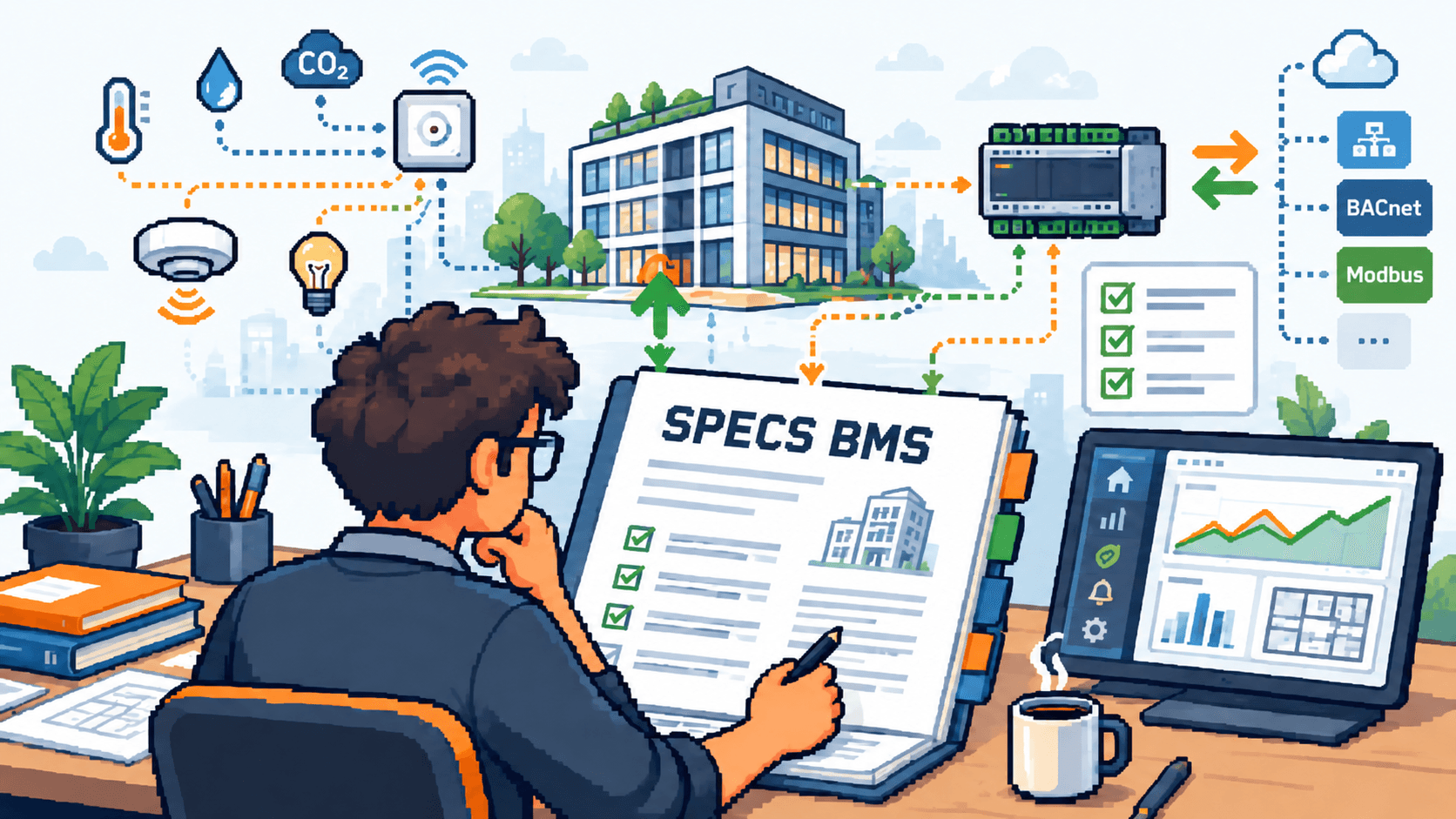
A BMS specification — in France the CCTP, the technical clauses of the works contract — dedicated to building management can look complete and say nothing about operation. In a commercial building, this technical document describes the supervision and controller-to-controller system that will run the heating, ventilation and air conditioning for twenty years. Every drafting mistake is paid for in lost energy performance , in a class never reached and in compliance never verified. Data confidentiality, operator training, day-to-day control: these subjects fall out of the specification in favour of a description of the hardware alone. Here are the 29 points we check before a specification goes out to tender.
In short — The BMS specification is the written document that sets out what the building management system must be able to do in a commercial building: control, trend logging, alarms, interoperability. What it does not contain will never be delivered.
The specification is the only moment when the client holds the pen
The BMS is the package where the client has the least in-house expertise and where the specification weighs the most. A badly built wall is visible. A badly programmed control sequence is not: it is paid for in kilowatt-hours and complaints across the whole life of the technical equipment.
Before signing, anything is possible. You can require the source code, an export of the logged data, an acceptance protocol with named tests. After signing, each of those lines becomes a quotation. The integrator reads the specification as a contract, because that is what it is.
This is the underlying asymmetry of the trade. The client decides with no in-house technical expertise, on a document they have no means of reviewing.
A real case: 6 out of 100
We went through a specification for replacing the controls on one office floor in the Paris region. Fan coil units, three zones, a migration from the LonWorks bus to IP, two supervision layers to feed. An ordinary job.
The scope was clear, the as-built documentation required with a firm deadline, functional testing planned.
What was missing: administration of the system and the network after handover, freedom for a third party to take over the programs, export of the trend logs, a naming convention, cybersecurity on a brand-new IP network, the annual cost of licences, operating scenarios and energy management.
That specification bought controllers and points. It did not buy an operable BMS. The design office that wrote it did nothing unusual. Standard market practice produces technical documents that describe the hardware and forget the operation.
A good specification does not name a brand
A hospital technical director, preparing for compliance with the BACS decree, asked me to help him choose the best BMS brand for his commercial building. My first instinct was to think about the "best" solution. Then I understood that this was not my role.
The role of the design team is to write what the building management system will have to be able to do, and how it will be verified: reliable data, interoperability without a licence, trend logging, export, defined use cases. The integrator knows the equipment and proposes the architecture that answers the BMS specification.
A good specification does not name a brand. It rules out the ones that cannot do the job.
If your specification reads "we want Distech Controls or Niagara, but not Siemens or Schneider Electric", question the approach. It is not that these brands are good or bad. It is that the line replaces verifiable requirements with a preference, and a preference cannot be tested at handover.
The 29 points that follow are written in that spirit. None names a product. Each describes a verifiable requirement.
Scope and responsibilities
- Does the specification list the equipment to be connected, and what is excluded? A list by technical package and by floor. Disputes at handover almost always start with a piece of equipment each party thought was in the other's scope.
- On a refurbishment: is the existing installation surveyed? For each controller, is it kept, migrated or replaced, and why? We have seen a maintenance contractor quote one million euros to replace three hundred controllers in an eleven-year-old building. Replacing a single one proved that a one-for-one swap was enough.
- Are responsibilities split between packages? Who supplies the AHU controllers, the sensors, the wiring? Which engineering office coordinates commissioning? With no interface matrix, the HVAC package delivers an AHU "with its controls" and nobody has written the sequence.
- Are the regulatory requirements and the target class set out function by function? The BACS decree sets its own functional requirements; NF EN ISO 52120-1 is an assessment framework. A line reading " class B BMS " scores 1 out of 3. A table of functions with the level required for each scores 3. If CEE funding is targeted (the BAT-TH-116 scheme), its own BMS class requirements come on top.
Common mistake — Three things the market confuses: the BACS decree imposes no class from NF EN ISO 52120-1. The BAT-TH-116 CEE scheme requires class A or B for the grants. A commercial building's class is that of its weakest function. BACS decree ≠ class ≠ CEE.
- Who administers the system, the access rights and the network after handover? Source code of the programs, licences in the client's name, administrator accounts. On the specification scored 6/100, nobody was named. The vacuum fills itself: with the integrator, who keeps the keys.
Use cases and operation
- Are the objectives translated into concrete use cases? The operator's typical day: what they look at in the morning, the equipment settings they adjust, what alerts them. A catalogue of functions is not a use case.
- Is a functional design document required and approved before programming? See below. It is the most profitable point on the list.
- Are overrides logged and reported, including those made at the panel? See below. The supervision layer must flag any equipment that has left automatic control.
- Is alarm management specified, and is the alarm list a deliverable? Prioritisation and routing at the very least. A system that reports 400 alarms of equal priority trains operators to read none of them.
- Can the controller programs be taken over by a third party without voiding the warranty? Sources delivered, standard programming tools, and a clause stating the warranty holds if another qualified integrator intervenes.
- Is remote control planned and secured? VPN, authentication, connection logging, network segregation.
- Is trend logging specified: which points, at what interval, over what depth? Analogue measurements every five minutes, states on change, three years rolling.
- Is interoperability required in practice? Points exposed over an open protocol, with no extra cost and no additional licence, for one person-day at most. See below.
- Can any logged data be exported easily, without a quotation? Format documented in the as-built pack, with no intervention from the contractor. One client had to dig his temperature history out of the backups. It had been his all along.
Omission no. 1: nobody wrote down what the system must do
A specification says "control according to occupancy" or "compensation curve". These are intentions. What is missing is the deliverable where those intentions become values: setpoint at 21 °C in occupancy, 17 °C at night, an alarm if the deviation exceeds 2 °C for an hour. That deliverable is thefunctional design document. It should be written by the integrator and approved by the client or their advisor before the first line of code.
Without that design document, the integrator programs their standard library. Point-to-point testing checks the wiring, not the behaviour. Three years later, whoever takes the building over has nothing but code to read. They propose to redo everything. That is where we come in, and it is the most avoidable BMS Advisory assignment in our catalogue.
Omission no. 2: the overrides nobody sees
On the door of an AHU panel, an auto / off / manual switch. A technician flips it to manual to fix something on a Friday, and leaves. The AHU runs at full speed nights and weekends until someone queries the bill. Nothing in the system signals that a piece of equipment is no longer being controlled.
The specification settles this in two lines: the switch position is reported as a point, and every override made from the supervision layer is logged with user, timestamp and automatic expiry.
A BMS that cannot say what it has stopped controlling is not a BMS, it is a display.
Omission no. 3: "the controllers support BACnet"
That sentence appears in most specifications and has never obtained anything. Supporting a protocol is a hardware capability. Exposing the points through that protocol is a service: configuration, naming, sometimes a licence to activate.
What needs writing: all points are exposed over an open protocol, with no additional licence, with the object list delivered in the as-built pack, and exposing further points takes no more than one person-day. A protocol mentioned is not interoperability required.
Mimic diagrams, dashboards and access rights
- Are user rights defined? A matrix of profiles (administrator, operator, manager, read-only) with the permitted actions.
- Is approval of the mimic diagrams and dashboards organised before delivery? A mock-up approved by the client before development. Screenshots "for guidance only" are not an approval.
- Can the screens be created or modified in-house? It is not essential, but every screen modified by the integrator is one more quotation.
Documentation and data quality
- Is the points list one of the deliverables? Complete, with addresses, units and expected ranges. It is the document everyone looks for the day something stops working.
- Is the sensor layout drawing a deliverable? A room sensor mounted above a radiator produces ten years of false data. Without a drawing, nobody finds out.
- Is a standardised naming convention imposed? Building, floor, zone, equipment, point. Without a convention, the installation becomes unreadable at the second extension.
- Is the metering plan with sub-meters a deliverable? On the specification scored 6/100, the energy dimension was absent: not one sub-meter, when the client will have to declare their consumption.
- Is commissioning of the sub-meters planned? Sum of the sub-meters against the main meter, with a signed record. We took over a new building where 230 sub-meters produced no usable data.
Maintenance, cybersecurity and testing
- Is cybersecurity addressed? Network segmentation, default passwords changed, an update policy, access logging.
- Are the handover documentation, the backups and the restore procedure required? The contents of the as-built pack listed, not just its deadline. And a tested backup: a system with no backup is rebuilt after the first failure.
- Is functional acceptance testing set out in detail? Point-to-point testing, sequence testing under real conditions, signed records, an observation period before defects are finally closed. An installation handed over in June has never been tested in heating. Plan a commissioning survey.
- Is operator training planned? Duration, audience, materials handed over. Half a day on handover day trains nobody.
The long run
- Does the contractor offer a maintenance contract, with its content and price known? Handed over at the latest at acceptance. After that, the client negotiates from a position of weakness, with a system only the contractor knows.
- Is the real annual cost known before signing? See below.
- Is the announced support life of the proposed controllers required? A controller whose manufacturer ends support in three years is planned obsolescence, bought new.
Omission no. 4: what the system costs once delivered
The specification fixes the price of the works. It almost always forgets to ask the price of the following years: software licences, subscriptions, updates, the cost of adding a point and, above all, the cost of leaving.
The mechanism is well known. The client needs a consumption history for an energy report. They ask. They receive a quotation, because the function was never delivered. Each request becomes a person-day. After two years, nobody dares ask any more.
Asking every bidder for a five-year annual cost costs nothing and changes how the offers compare.
Five lines that change the handover
There is no need to rewrite the specification. What is needed is to add the requirements that protect operation, and to phrase them so they can be verified — otherwise they are worth nothing. A building's energy performance is decided in those lines.
To require in writing, and to test at handover
- A functional design document written by the contractor, with setpoints, time schedules and quantified sequences, approved by the client before programming.
- Source code of the programs and licences in the client's name, delivered in the as-built pack, modifiable by any qualified integrator without voiding the warranty.
- Overrides logged (user, timestamp, expiry), including the position of the panel switches reported as a point.
- Export of any trend log in CSV at the very least, with no intervention from the contractor; points exposed over an open protocol with no additional licence.
- Five-year annual cost quantified by every bidder, and a maintenance contract offer handed over at acceptance.
Those five lines are not enough to make a good specification. They are enough to make the difference between a system you own and a system you rent from your integrator without knowing it.
FAQ
What is a BMS specification?
A BMS specification — in France the CCTP, the technical clauses of the works contract — sets out the functions expected of the system that will run the heating, ventilation and air conditioning of a commercial building. It fixes the requirements that can be verified at handover. Assuming it exists at all: on many projects the BMS has no package of its own, and its specifications amount to a few pages tucked inside the electrical package or the mechanical package. Nobody then carries the subject from end to end.
What is the difference between a BMS and supervision alone?
Supervision alone displays: screens, alarms, history. A BMS adds control and controller-to-controller communication: the system writes setpoints onto the equipment and drives the HVAC sequences. In practice the two are often confused. What matters is what the system actually does on site.
Which standards apply to a BMS specification?
NF EN ISO 52120-1 classifies control and building management functions. The BACS decree sets its own functional requirements for commercial buildings in France (above 290 kW since 1 January 2025, 70-290 kW postponed to 1 January 2030). Regulation and standard complement each other without overlapping.
How do you build the BACS decree into a BMS specification?
The specification must set out the decree's functional requirements function by function (setpoint management, consumption monitoring) rather than simply naming a class. If CEE funding is targeted (the BAT-TH-116 scheme), the class A or B requirements come on top. The energy efficiency of the building depends on that precision in the drafting.
Which equipment should be connected to a BMS?
The specification must list the equipment by package: AHUs (heating, ventilation, air conditioning), boilers, chillers, heat pumps, fan coil units, lighting, domestic hot water and sub-meters. Control also covers blinds and occupancy detection where the building warrants it. The connection works are detailed floor by floor.
Is your specification scoring below 60? Our advisory team checks your technical requirements against the 29 criteria and fills the gaps before you go out to tender. Every mistake corrected at this stage saves a quotation in operation.
Have your specification scored before you publish it
We have put online the tool that produced the 6/100 above. It reads a BMS specification and scores it against these 29 criteria, 0 to 3 each: absent, mentioned, addressed, verifiable at acceptance. The tool is instructed to be demanding. A 3 is rare, and simply mentioning BACnet does not earn a 3 on interoperability.
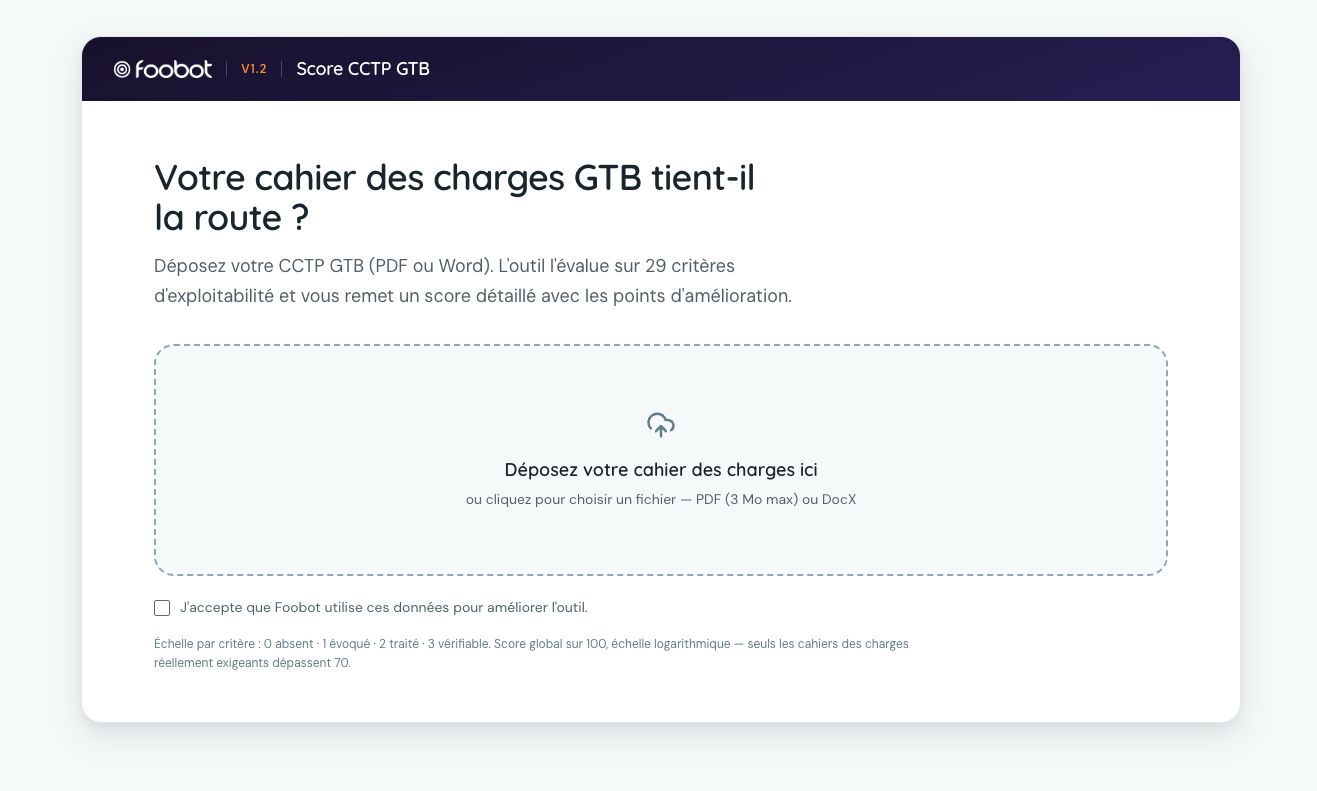
The tool does not replace an advisory assignment. It reviews, says what is missing and proposes wording for each gap. If it scores 60, you have a sound document and a few lines to add. If it scores 6, there is still time: nothing has been signed.