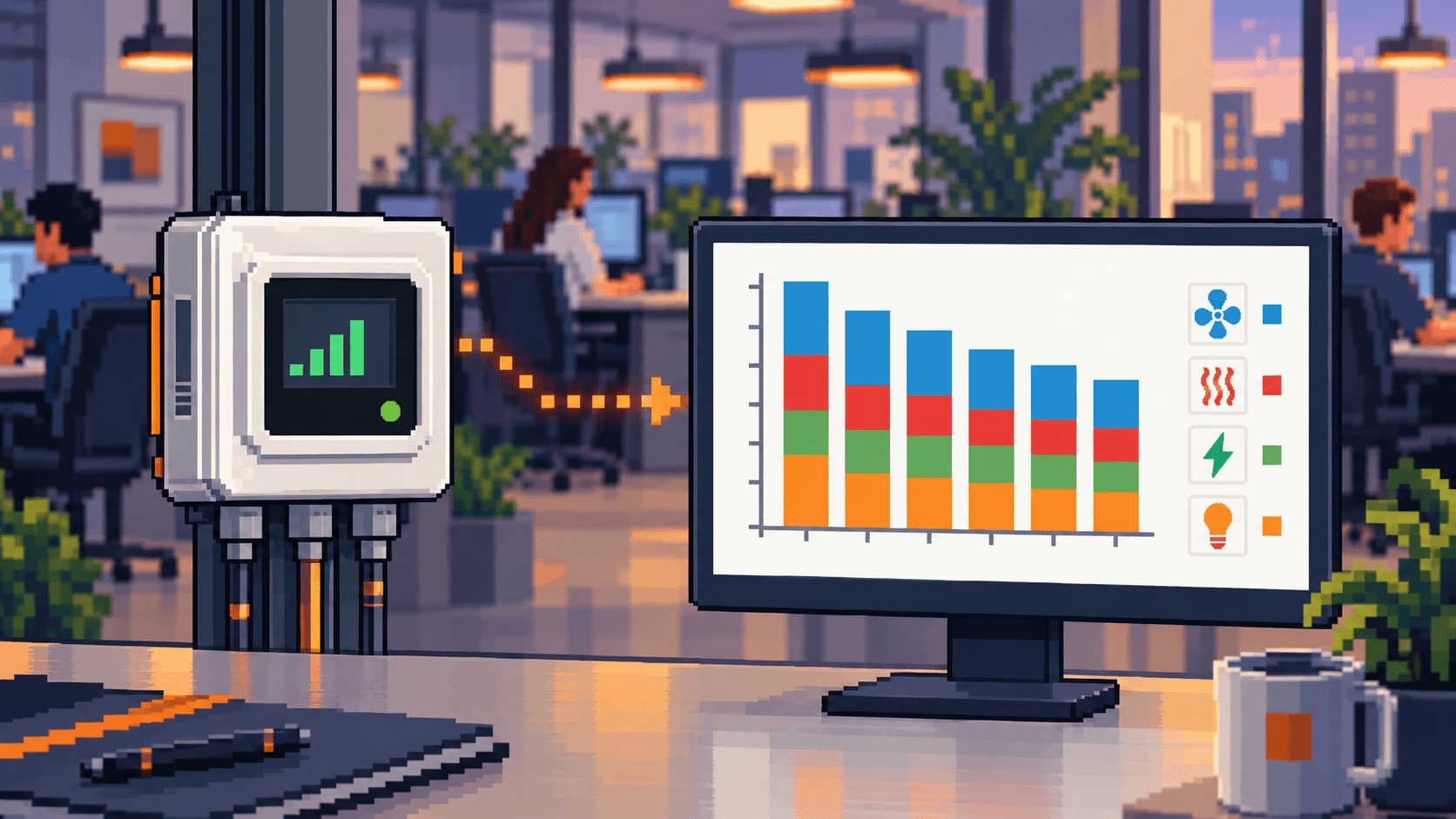
The Foobot x Smart Impulse partnership, working for energy performance
At Foobot, we deploy AI agents that continuously optimize the HVAC systems of commercial buildings and healthcare facilities. Our technology acts like an energy engineer who knows your building inside out. But for that AI to perform at its best, it needs one essential thing: reliable consumption data, broken down by end use.
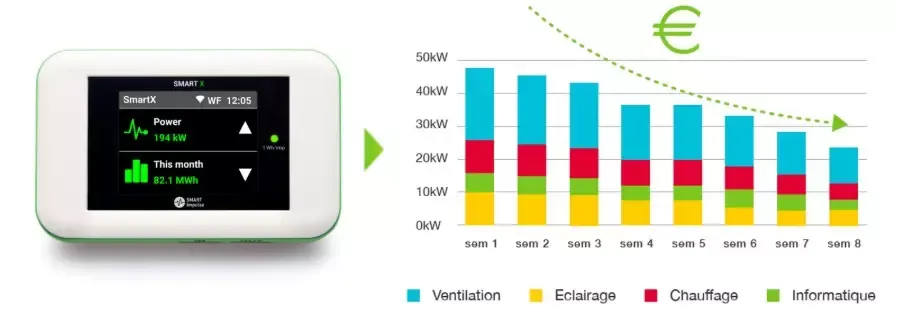
That is precisely what Smart Impulse brings to the table. From a single smart meter and AI-based algorithms, their measurement solution delivers a breakdown of a building's consumption by end use (lighting, IT equipment, heating, and so on). That level of granularity lets our AI work with unmatched precision.
1) The challenge of intelligent HVAC control
HVAC systems account for an average 50% of the energy consumption of commercial buildings in Europe. Against a backdrop of the Décret tertiaire (France's energy reduction mandate for commercial buildings) and BACS obligations, asset managers are looking for ways to cut that consumption without affecting occupant comfort.
The problem? Existing Building Management Systems (BMS) are commissioned once, then rarely optimized again. Settings drift, conditions change (weather, occupancy, usage patterns), and consumption creeps up unnoticed.
Foobot answers that challenge with a radically different approach: our AI trains on a calibrated digital twin of the building, then controls the key BMS parameters in real time. It anticipates, adjusts, and corrects drift automatically.
2) Smart Impulse: the data that feeds our AI
To train our AI and measure its performance, we need energy data that is reliable, continuous and broken down by end use. Smart Impulse gives us exactly that.
a) A reliable baseline for learning
Through the Smart Impulse API, we retrieve HVAC consumption data isolated from every other end use. That lets us build a robust baseline on which to calibrate our digital twin and validate our models against the ASHRAE G14 standard.
b) Transparent reporting of savings
Once the AI is deployed, Smart Impulse data makes it possible to precisely quantify the savings achieved on HVAC, building by building, season by season. No more doubt about "what was really saved": the proof is in the data.
3) Our technology: deep reinforcement learning and digital twins
Unlike static rule-based systems or the MPC approaches used by our competitors, Foobot relies on deep reinforcement learning (DRL) - the same technology behind DeepMind's AlphaGo. Our AI trains in a virtual environment on the equivalent of more than 800 years of data, building a uniquely strong ability to adapt to the unexpected.
In practice, the Foobot AI optimizes:
- heating and chilled water curves (hot and cold circuits),
- air curves (air handling units),
- equipment start and stop schedules,
- and any other parameter that drives consumption.
Key point: Foobot does not replace the BMS. It connects to it as an intelligent layer, interoperable and reversible (it can be switched off at the press of a button).
4) A real-world case: commercial offices, measurement plus AI control
A representative example of our approach involves office buildings of roughly 13 000 m², where Smart Impulse and Foobot were deployed together.
The process:
1. Smart Impulse installation: a fast metering plan, with no shutdown, isolating HVAC consumption precisely.
2. Building the Foobot digital twin: modelling the building, calibration to ASHRAE G14, training the AI.
3. Connection to the BMS: deploying the AI through an API or a dedicated gateway.
4. Continuous control: adjustments every 15 minutes, optimization driven by real conditions.
5. Consolidated reporting: savings tracked by end use thanks to Smart Impulse data.
Measured results:
27% savings on HVAC against the 2022 baseline year, that is 170 MWh saved and around €60,000 in gains - all of it with no loss of thermal comfort.
5) Fast payback and a frugal AI
Combining Smart Impulse and Foobot accelerates the return on investment:
- Foobot: typical return on investment of 12 months or less depending on the size and configuration of the building.
- Smart Impulse: makes it possible to prioritize the right actions from the outset, and to put hard numbers on the gains throughout the project.
Our AI also stands out for its exemplary carbon footprint: 1 tonne of CO₂ emitted for 700 tonnes saved. Unlike power-hungry LLMs, deep reinforcement learning is a frugal, robust and deterministic technology.
Conclusion: measure better to control more precisely
The Foobot x Smart Impulse partnership illustrates a firm conviction: energy control AI can only excel if it is built on quality data. By combining Smart Impulse's end-use measurement with Foobot's continuous optimization, we give asset managers a complete solution to:
- Understand precisely where the energy goes
- Optimize HVAC continuously, with no capital works
- Prove the savings achieved
- Sustain performance over time
Article written in collaboration with the Smart Impulse team. Thanks to Sabine Dorgan for their contribution.
FAQ - Definitions
HVAC: what does it stand for?
HVAC stands for Heating, Ventilation and Air Conditioning. The term covers the systems that deliver thermal comfort and air quality in a building, and it is often one of the highest-impact areas to optimize in operation in order to cut a building's energy consumption.
Deep reinforcement learning: what is it?
Deep reinforcement learning (DRL) is a branch of artificial intelligence in which an agent learns to make optimal decisions by trial and error in a simulated environment. It is the technology DeepMind used to beat world champions at the game of Go. Unlike generative AI (LLMs), DRL is deterministic, reliable and suited to industrial control.
Digital twin: what does that mean?
A digital twin is a virtual replica of the building that faithfully reproduces its thermal and energy behaviour. Calibrated to the ASHRAE G14 standard, it makes it possible to train the AI and to predict achievable savings before any deployment.
Décret tertiaire: a reminder
The Décret tertiaire (Éco Énergie Tertiaire, France's energy reduction mandate for commercial buildings) requires a progressive cut in the energy consumption of commercial buildings over 1,000 m²: -40% by 2030, -50% by 2040, -60% by 2050. Owners and operators must declare their consumption every year on the OPERAT platform.
Back to blog