Independent BMS design consultant: the engineers who test what they specify
On many projects, whoever writes the BMS specification is also the one installing it. They respond to their own requirements, then sign off their own handover. Foobot takes the design role with nothing to sell afterwards: no controllers, no supervision software, no works.
- Independent from integrators
- Open protocols: BACnet / LON
- Acceptance tested on site
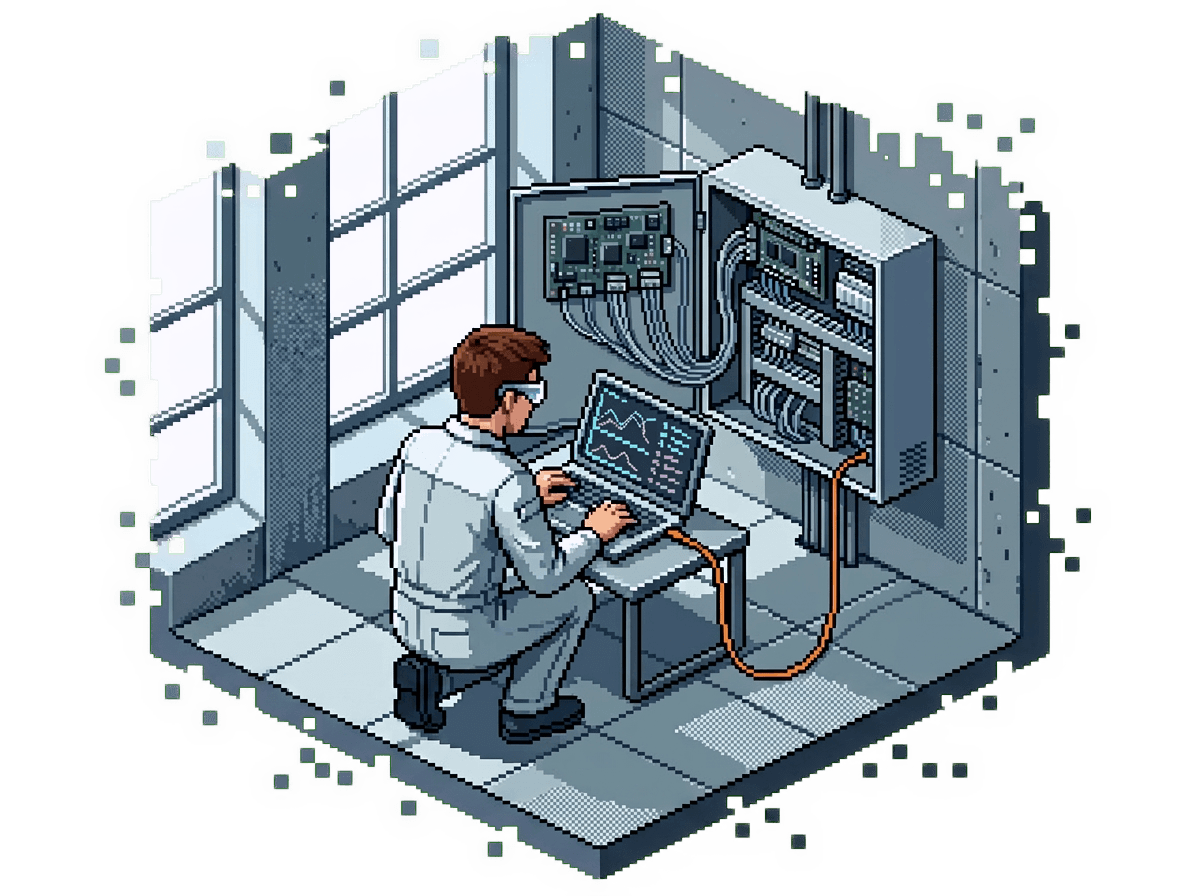









A BMS project: four parties, and three questions nobody owns
On paper, the chain is crystal clear. The building owner decides, the BMS consultant designs, the integrator installs, the operator takes over. In reality, the boundaries blur from the very first site meeting.
- Building owner
Carries the budget, the decision and the regulatory risk.
- BMS consultant / lead designer
Designs the architecture, writes the specification, follows the works.
- Integrator
Installs, programs the controllers, commissions.
- Operator
Lives with the system every day, long after handover.
Who tests the sequences before handover is signed?
When the specification does not say, acceptance boils down to a tour of the supervision screens. The graphics load, so "it works". Three months later the first malfunctions surface, with no clear recourse.
Who checks that the points report reliable data?
You may have 500 BMS points. The real question is how many of them tell the truth. A wrongly addressed sensor, a meter counted twice, a frozen probe: nobody sees it until somebody looks.
Who actually trains the operator?
Half a day in front of the supervision screen is not a skills transfer. An operator who does not understand the control logic switches to manual override. And overrides stay.
The conflict of interest everyone accepts
When the design consultant is also the integrator, they specify, respond to their own specification, check their own commissioning and approve their own handover. The building owner is left with a single opinion, and it comes from whoever sells the works.
"A BMS handed over with zero defects, yet unusable. Why? Because it was never tested. The BMS consultant just had a chat with the integrator over lunch. That is not enough."
What a BMS design engagement with Foobot includes
Ten points we write into the specification, then verify ourselves. You can also use them as a checklist to read any BMS design or project management proposal.
Independence from the integrator
No financial or commercial tie with the company doing the installation. You cannot be both judge and party.
Functional requirements per system
Heating, ventilation, cooling, lighting, metering: each system gets its own requirements. An AHU sequence is not written like lighting control, and a specification that describes everything "as a whole" leaves gaps.
Target BMS class and French BACS decree requirements
The French BACS decree sets its own functional requirements. It does not impose a class from EN ISO 52120-1. The class is there to set the ambition of the project, bearing in mind that a building is rated on its weakest function.
Open protocols, mandated
BACnet or LonWorks written in black and white in the specification. A proprietary network locks up access to the data and makes every upgrade more expensive than the last.
Functional testing before handover
Every control sequence is verified under real conditions, controller powered up, not simulated on a supervision screen. No test, no handover.
Documented control sequences
Trigger conditions, setpoints, alarm thresholds, degraded-mode behaviour. Without that documentation the operator works blind and the next integrator starts from scratch.
Operator training
The operator needs to understand the control logic and handle the common cases: manual overrides, recurring alarms, communication faults.
Follow-up through the warranty year
Clearing defects, checking performance in winter then in summer, adjusting setpoints. Once the defects liability period is over, getting anything fixed means paying for it.
Reversibility and data access
Your BMS history belongs to you. Export in an open format, and the ability to change integrator or supervision software without losing information.
Performance measurement criteria
Consumption baseline, verification protocol, weather normalisation: the method is defined in the specification. Without it, the savings announced remain claims.
Already have a specification or a design proposal? Send them over and we will tell you what is missing.
Integrator-tied or independent BMS consultant: what changes for the building owner
| Criterion | The usual setup | Foobot engagement |
|---|---|---|
| What they have to sell you next | The usual setupOften the integration, the hardware or the maintenance | Foobot engagementNothing. No controllers, no supervision software, no works |
| Protocols | The usual setupThose of the product range the integrator knows | Foobot engagementBACnet or LonWorks mandated, reversibility clauses |
| Handover | The usual setupA tour of the supervision, certificate signed | Foobot engagementSequences tested one by one, under real conditions |
| Documentation | The usual setupO&M manual delivered, rarely read | Foobot engagementSequences described, usable by a third party |
| End of engagement | The usual setupAt delivery, sometimes at the end of the warranty year | Foobot engagementFollow-up through the warranty year, until defects are cleared |
| Measuring savings | The usual setupSelf-declared, or missing | Foobot engagementMethod set in the specification, IPMVP protocol with degree-day normalisation |
The usual setup describes what we come across most often in the field. There are good BMS consultants tied to an integrator. The point is that you have no way of checking.


“We had a brand-new BMS, but it wasn't delivering on its promises: uncomfortable occupants, constant alerts, and the feeling of no longer really being in control of our building. Foobot, as our BMS advisor, helped us take back control and bring the BMS up to the expected standard.”
“Comfort that is finally stable for our teams, and significant energy savings.”
Why a control software company makes a good BMS design consultant
Foobot does not know BMS only because we audit them. We started out writing software that actually has to work with them.
We have been under the hood
Reading data, writing setpoints, testing interfaces, watching how HVAC equipment reacts. We have been doing it for years, on BMS from different manufacturers. We know what a vague requirement costs later on.
Foobot BMS advisoryTests, not site visits
Our DNA comes from IT: automated tests, reproducible methods, data qualification, regression detection. Our opponent is not the controls engineer. It is craft-style software applied to systems that have become critical.
BMS handover and warranty yearThe next step, only if the building calls for it
A reliable BMS has value in itself. There is not necessarily an AI phase behind it. When there is real complexity to manage, AI control regulates the HVAC every 15 minutes through the existing BMS. At Valeo: −28.6% HVAC consumption, measured under the IPMVP protocol.
AI controlBMS consultant, lead designer, owner's advisor: the questions we get
What is the difference between a BMS design consultant, a BMS project manager and a BMS advisor?
The BMS design consultant designs the system and writes the specification. The project manager (maître d'œuvre, in French projects) coordinates the works and pronounces handover. The owner's advisor (AMO) counsels the building owner and checks what is delivered. On many commercial projects these roles end up with the same party, sometimes the integrator itself. Foobot handles design, follow-up and verification. Never integration.
Is Foobot really independent from BMS integrators and manufacturers?
Foobot sells neither supervision software nor controllers, and carries out no works. EnergyWise SAS, which operates Foobot, is a French SME with no financial tie to any BMS integrator or vendor.
When should the BMS design consultant come in?
As early as possible, before integrators are invited to tender: the specification is what protects you if there is a dispute over what was delivered. We also step in during the works, or only for handover and the warranty year when the project is already under way.
Do you work on existing BMS, or only on new builds?
Both. On refurbishments we start by looking at what already works. Equipment declared obsolete sometimes still runs perfectly well, and a full replacement is not always the right answer to a compliance deadline.
Does the French BACS decree impose a BMS class?
No. The decree sets its own functional requirements and does not impose any class from EN ISO 52120-1. Commercial buildings above 290 kW had to comply by 1 January 2025. For the 70-290 kW bracket, the deadline was pushed back to 1 January 2030 by decree no. 2025-1343 of 26 December 2025.
How much does a BMS design engagement cost?
We do not know yet: we need to look at the project. The fee depends on the number of systems, the number of points, the level of testing required and how long the post-handover follow-up lasts. A first 15-minute call is usually enough to frame the scope.
A BMS project to frame, or a specification to have reviewed?
15 minutes with a Foobot engineer. We look at your project, your BACS timeline and what your specification should contain. No commitment.