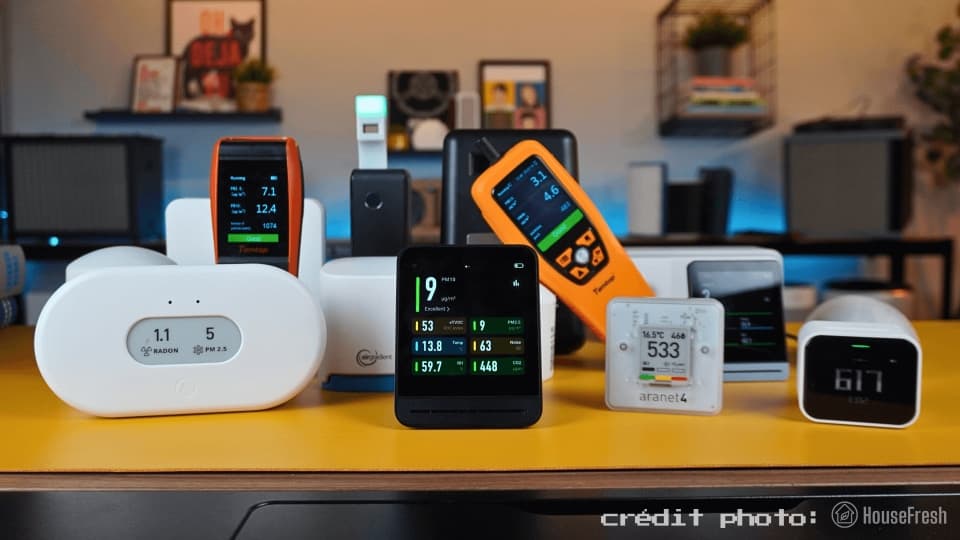
From carbon monoxide to formaldehyde to fine particulate matter, air pollutants are extremely dangerous. Monitoring air quality with a professional indoor air quality monitor is an essential step toward better health and positive environmental outcomes. It is also only a first step: a reading that nobody acts on does not change the air anyone breathes.
Why Choose an Air Quality Monitor?
Since air pollution is a global concern, more and more regulatory bodies and international organizations recommend using an air quality monitor. Modern monitors can:
- Provide fast insights through wireless, continuous, and low-cost monitoring.
- Share their data over the cloud or a building network, which makes it possible to set up automation scenarios with other equipment, such as the ventilation system, and to follow the readings in a software application.
- Lead to concrete measures and improve the health performance of private buildings as well as public spaces.
- Detect dangerous concentrations and emissions, which can bring about a shift in mindset toward better environmental protection.
Outdoor vs. Indoor Air Quality Monitors
Outdoor pollution is a fact: industrial emissions, exhaust fumes, soot, and so on. Indoor air quality (IAQ), on the other hand, is also a major health concern. Whether it comes from new furniture or smoke, indoor pollutants can be dangerous. Since natural ventilation is one of the main ways to reduce dangerous concentrations of VOCs and other gases, outdoor pollution is often closely tied to IAQ. It is no secret that when outdoor air is polluted, it is better to close the window and trust the building's HVAC system! To help people keep both outdoor and indoor air quality in check, air quality monitors are essential.
Outdoor air quality monitors, in particular, are designed to detect toxins such as:
- Ozone
- Vehicle emissions
- Particulate pollution
- Nitrogen dioxide (NO2)
- Sulfur dioxide (SO2)
- Carbon monoxide (CO)
- Radon
Note that radon has been linked to serious health problems, such as lung cancer, while nitrogen oxides (for example NO2) lead to the formation of environmental anomalies, such as acid rain.
Indoor air quality monitors, for their part, are most often designed to detect:
- Particulate pollution
- Volatile organic compounds (VOCs)
- Carbon dioxide (CO2)
- CO
- Radon in ground-floor homes, where this substance may be present
In addition, indoor air quality monitors can measure other relevant factors that can affect IAQ, such as humidity and temperature.
Choosing a Monitor: What Really Matters
Although individuals cannot escape global environmental problems, such as vehicle emissions, they can easily monitor and regulate the IAQ of their home or workplace. Moreover, people spend 90% of their time indoors, which makes indoor air quality monitoring essential. However, with ever-advancing technology, the question is which sensor to trust: a laboratory-grade instrument that gives a high-resolution but hard-to-understand picture, or an inexpensive connected monitor that fits on a shelf?
Accuracy varies more than the marketing suggests. The Lawrence Berkeley National Laboratory tested seven consumer indoor air quality monitors[1] against reference laboratory equipment. For fine particulate matter (PM2.5), one of the most dangerous pollutants, some devices tracked the reference instrument consistently and linearly, while others were sometimes right and sometimes well off. The same low-cost sensor technology can therefore produce very different results depending on the calibration and the algorithms behind it.
The key aspect is a monitor that measures what really matters. Criteria pollutants, such as particulate pollution, and VOCs, such as formaldehyde, are important. Understanding their origins and harmful effects is the first step toward better IAQ. Therefore, a good indoor air quality monitor must have accurate, calibrated sensors across all monitoring locations. In addition, the readings need a good application to help users interpret the data: applications are not just accessories but necessities for visualizing data. Finally, any good monitor should prompt users to take action. Note that some effective measures to reduce air pollution include using reliable ventilation systems and filters, air-purifying plants, and low-VOC building and cleaning products.
From Measurement to Action: Where Foobot Comes In
In a commercial building, the monitor is rarely the missing piece. What we observe is that many buildings already have CO2, VOC, or particulate sensors, and that the air handling units (AHUs) and rooftop units (RTUs) keep running on fixed schedules regardless of what those sensors read. Meeting rooms are ventilated at full rate while they are empty, and under-ventilated as soon as they fill up. The data exists; it just never reaches the equipment.
Foobot is not a monitor. It is an AI technology that uses the data from the building's IAQ sensors, together with occupancy, weather, and the equipment's own operating data, to control the air renewal equipment through the building management system (BMS). Fresh air flow rates on AHUs and RTUs follow the actual pollutant concentrations and occupancy, instead of a time schedule: more fresh air when CO2 or VOCs rise, less when the space is empty or the outdoor air is polluted. The result is a ventilation system that responds to air quality rather than to a clock, without ventilating at full rate 24/7 to be on the safe side.
This only works if the sensors are reliable, which brings the discussion back to accuracy: a control strategy is only as good as the data it is fed. Before any optimization, the sensors and the BMS points they feed have to be checked and, where needed, put back in order.
To sum up, air quality monitors are not just household accessories gathering dust.
- Monitoring air pollution and IAQ (for example criteria pollutants and VOCs) can improve health outcomes.
- Good air quality monitors require accurate sensors to detect dangerous compounds (for example nitrogen dioxide or radon). Nevertheless, any good monitor goes hand in hand with a good application to make the data easy to understand and visualize.
- In buildings, measurement pays off when it drives the ventilation equipment: this is what Foobot does, by using IAQ sensor data to control AHUs and RTUs.
- The environmental impact of pollution (for example exposure to fine particulate matter) can be deadly. Therefore, as mentioned above, air quality monitors are not just accessories but enablers of clean air and a healthy lifestyle.