By 1 January 2030 at the latest, an existing commercial building of 70 to 290 kW will have to monitor its consumption at hourly intervals, unless an exemption provided for by the text applies[1][1]RegulationLégifrance, “Decree No. 2020-887 of 20 July 2020 on building automation and control systems in non-residential buildings and automatic heat regulation”, BACS decree, amended by Decree No. 2023-259 of 7 April 2023 and codified in Articles R. 175-1 to R. 175-3 of the French Construction and Housing Code (code de la construction et de l’habitation)See in sources ↓[2][2]RegulationLégifrance, “Decree No. 2025-1343 of 26 December 2025”, postponing the BACS deadline for 70 to 290 kW buildings to 1 January 2030See in sources ↓. The BACS decree (French decree 2020-887 on building automation and control systems) sets the deadline. A screen will not be enough if nobody corrects the drift in the BMS.
Displayed data is not qualified data. An alert with no recipient triggers nothing. Here is what to require from energy supervision and its connection to the BMS so that energy monitoring ends in action.
Energy supervision: from what the tool sees to action on the BMS
Energy supervision: collect, normalize, detect
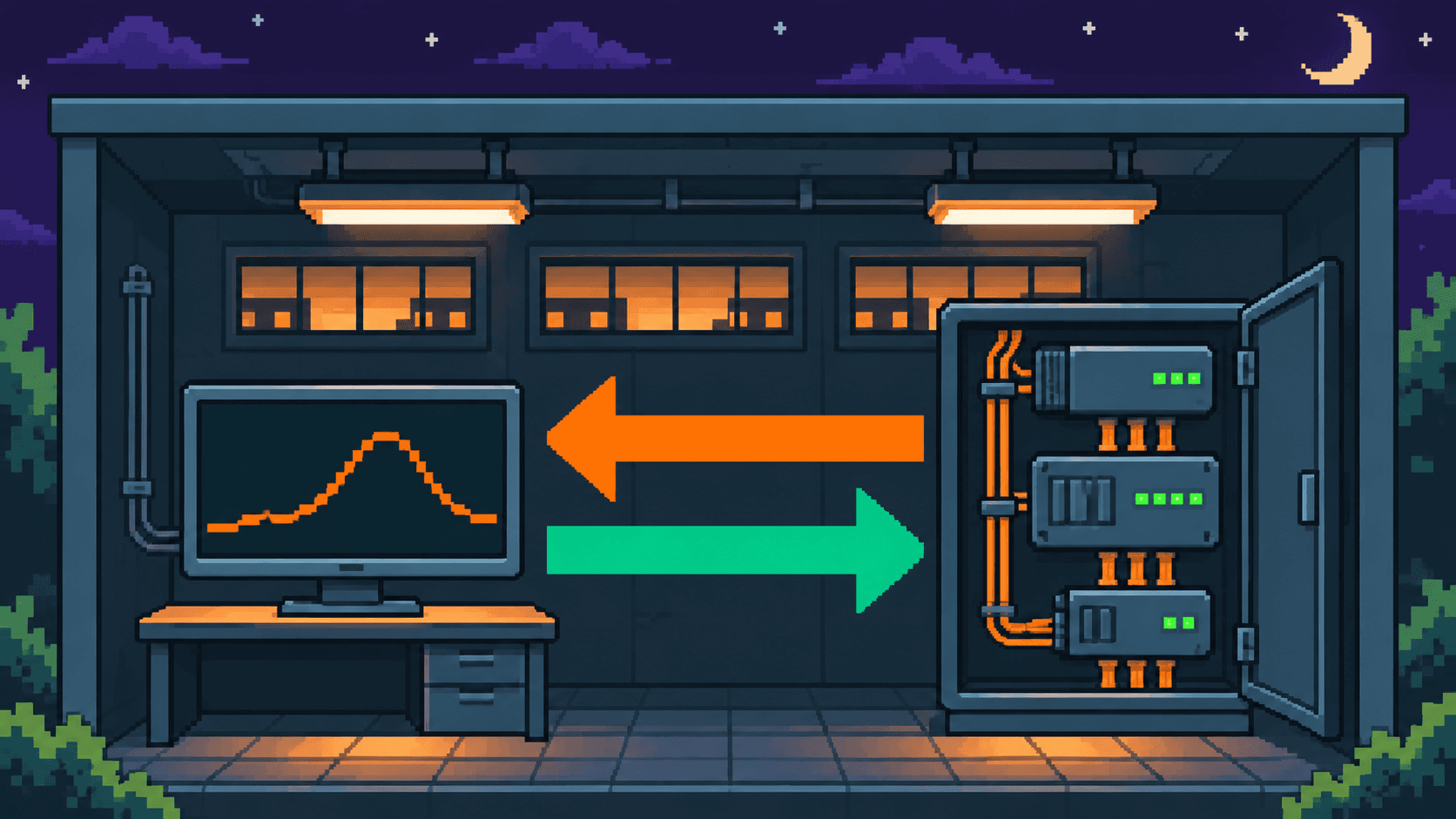
Energy supervision means collecting data from meters and from the points of the building management system (BMS). It then normalizes that data for heating degree days (HDD, called DJU in France) and occupancy, and uses it to detect drift. Monitoring draws curves; supervision compares what is consumed with what should be.
Supervision serves a broader approach, energy management: continuous improvement formalized in an EnMS (energy management system in the ISO 50001 sense, called SMÉ in France). This approach is equipped with an EMS (energy management software), sometimes called GTE in France (gestion technique énergétique, technical energy management). The EMS in turn feeds on the metering plan. When the portfolio has several sites, hypervision aggregates them, with each building keeping its own BMS.
BMS supervision, EMS and hypervisor: which tool for which role?
The BMS acts on the equipment. The EMS measures, alerts and writes setpoints to it. The hypervisor aggregates several sites and several BMS brands. Our article EMS, BMS, hypervisor details these boundaries: supervision and hypervision do not meet the same need.
Hence our position: an EMS that does not write to the BMS remains a dashboard. An IoT platform mainly sells its connector, yet the connector is not where the value lies. A supervision tool is judged by what it gets corrected, not by the number of screens in the software.
Observe, alert, control, optimize: the four levels compared
The same word, supervision, covers four levels of tools that contracts readily confuse. The table follows a single alert through these four levels: what the tool does, who has to act and what happens if nobody acts.
| What the tool does | What it sees: time step, scope | Who has to act | If nobody acts | How savings are verified |
|---|---|---|---|---|
| Energy tracking Observe | ||||
| Compiles invoices and meter readings. | The month, the whole building. | Nobody: no action is planned. | The drift shows up in the annual review. | They are not verified: raw year-on-year comparison. |
| Supervision or monitoring Alert | ||||
| Collects, normalizes for HDD, alerts. | Hourly or finer, per meter and per zone. | A recipient named in the contract. | The alert piles up on top of the previous ones. | Deviation from an HDD-corrected baseline. |
| BMS that controls Control | ||||
| Applies setpoints, schedules and sequences to the equipment. | The control points, continuously. | Operator or maintenance contractor. | Manual overrides become permanent, the setpoint drifts. | Through supervision, not through the BMS itself. |
| Predictive control Optimize | ||||
| Writes HVAC setpoints into the existing BMS at short intervals, for example every 15 minutes. | BMS trend logs, weather, thermal inertia, occupancy. | A manager approves the write limits. | The building falls back to its local control. | IPMVP protocol with HDD correction, auditable by a third party. |
Stop at the question “who has to act”. In most contracts, the answer is missing or points to “the operator” with no further detail. Energy tracking and energy monitoring stop at the observation, whatever their time step. Only the last two levels act on heating, ventilation and air conditioning: the EMS detects, the BMS corrects. Between the two, writing must be authorized, bounded and logged.
Setting up energy supervision in 5 steps
1. Draw up the metering plan and the BMS points inventory
Before any setup, two lists. The metering plan states which uses are measured and by which meter. It includes electrical sub-metering per switchboard, thermal energy on the hot water and chilled water loops, and the AHUs (air handling units) that provide ventilation.
The BMS points inventory lists each sensor (temperature, flow, occupancy) and each accessible setpoint. Without these two lists, the tool will display whatever is connected to it, not what needs to be seen.
2. Qualify the data, from meter to screen
A consumption value passes through five links before reaching your dashboard. The diagram follows its path, names the fault lurking at each link and groups the six tests to request from the operator.
Wrong data does not show on screen: a flat curve looks like an energy-efficient building, a duplicate like a rise in consumption. It has to be tested, link by link, before any analysis.
A meter cut off from the network or misconfigured comes out of the metering plan until it is fixed. Otherwise it produces false alerts, which are therefore ignored.
3. Build an HDD-corrected consumption baseline
The consumption baseline provides the detection reference: what the building should consume given heating degree days (HDD) and its occupancy.
Take an AHU whose consumption rises day after day, until the filter change alert. Without a baseline, the slope passes for a weather effect. With one, the analysis flags it well before the alert.
4. Write alert rules that someone will read
A few useful alarms are better than hundreds of ignored ones. Each rule names the expected deviation, the threshold and the person who receives it: the energy manager for a slow drift, the operator for a manual override.
An alarm nobody reads is worse than no alarm at all: it gives the illusion of monitoring.
5. Assign each alert to an action on the BMS
Each alert gets a four-field sheet:
- The alert, with its threshold
- The action to write into the BMS
- The person who carries it out
- The response time
BMS writing is the operation that turns supervision into savings: changing a setpoint, correcting a schedule, releasing a manual override. As long as this implementation remains an email to the operator, the BMS keeps running as before.
Choosing an energy supervision tool and connecting it to the BMS: protocols, writing, reversibility
Start from the drift to detect, not from the feature catalog
A tender starts with a list of drifts. A feature grid comes afterwards. Optimal start too early on Monday, a manual override forgotten since the summer, a meter silent for weeks: each operating company keeps its own list. Then check that the supervision tool can see these drifts and then get them corrected. Optimizing the optimal start is pointless on a faulty meter.
- Disconnections
- Data gaps
- Duplicates
- Invisible drifts
The meter reliability audit results in a list of verified drifts: the one to include in the tender.
BMS gateway, multi-protocol controller or API: three ways to connect an EMS
The BMS gateway translates one protocol into another. Reading works well. Writing depends on its configuration and on the integrator who maintains it.
For EMS-BMS integration on a site with several brands, the multi-protocol controller reads several buses at once, whatever the technology. It writes setpoints as soon as it has access to the system network.
The BMS API exposes the points to the software layer, between supervision and hypervision, without any added box. Its implementation depends on the software vendor, who also maintains it.
Which protocol to choose between BACnet and Modbus for an EMS?
A BACnet EMS reads named and typed building objects, with write priorities. Modbus carries registers with no semantics. Without a mapping table, a supervision solution reads numbers without knowing what they measure.
OPC UA is found mainly on the industrial side. LonWorks, often shortened to LON, is still present in older portfolios. The right protocol is the one your system already speaks.
Can an EMS be connected to an older BMS (LON, proprietary)?
Yes, in most cases, by going through the BMS: the existing supervision or a multi-protocol controller, without replacing any equipment. The real limit lies in the points documentation, rarely in the hardware.
An old BMS is not an obsolete BMS. Before pricing a BMS replacement, take stock of what it already exposes.
How many points should be exposed? Do you have to pay for point licenses?
The exposed points follow from the drifts to detect, not from the full inventory. Exposing everything drives up the cost without improving detection.
Read the integrator’s offer: some supervision systems charge licenses per point. A point opened for writing commits you more than one opened for reading. You need to know who writes, when and within which limits.
My integrator refuses to open the BMS: is that normal?
Rarely. Dependence on a BMS company remains the dysfunction we encounter most often. Yet the BMS data belongs to the system owner, not to the partner who installed the controllers[1][1]RegulationLégifrance, “Decree No. 2020-887 of 20 July 2020 on building automation and control systems in non-residential buildings and automatic heat regulation”, BACS decree, amended by Decree No. 2023-259 of 7 April 2023 and codified in Articles R. 175-1 to R. 175-3 of the French Construction and Housing Code (code de la construction et de l’habitation)See in sources ↓.
Security is sometimes a legitimate argument: network segmentation, dedicated accounts, logged writes. These measures can be negotiated. A refusal with no costed alternative is a pretext.
Time step, granularity and trend logging: the figures to require
Require an hourly time step, data per functional zone and five years of monthly data[1][1]RegulationLégifrance, “Decree No. 2020-887 of 20 July 2020 on building automation and control systems in non-residential buildings and automatic heat regulation”, BACS decree, amended by Decree No. 2023-259 of 7 April 2023 and codified in Articles R. 175-1 to R. 175-3 of the French Construction and Housing Code (code de la construction et de l’habitation)See in sources ↓. Real time is not a requirement: an hourly time step is enough to detect drift.
Standards and decrees: what the texts require of energy supervision
BACS decree: hourly time step, five years of history and interoperability
The BACS decree, for building automation and control system, has applied to existing buildings since 1 January 2025[1][1]RegulationLégifrance, “Decree No. 2020-887 of 20 July 2020 on building automation and control systems in non-residential buildings and automatic heat regulation”, BACS decree, amended by Decree No. 2023-259 of 7 April 2023 and codified in Articles R. 175-1 to R. 175-3 of the French Construction and Housing Code (code de la construction et de l’habitation)See in sources ↓. It covers any commercial building whose heating or air conditioning systems exceed 290 kW. For the 70 to 290 kW bracket, the deadline moves from 1 January 2027 to 1 January 2030[2][2]RegulationLégifrance, “Decree No. 2025-1343 of 26 December 2025”, postponing the BACS deadline for 70 to 290 kW buildings to 1 January 2030See in sources ↓. New buildings do not benefit from this postponement. The text sets its own functional requirements and does not impose any NF EN ISO 52120-1 class[3][3]Standards and protocolsAFNOR, “NF EN ISO 52120-1”, Energy performance of buildings - Contribution of building automation, controls and building management - Part 1: General framework and proceduresSee in sources ↓.
- BACS decree: hourly monitoring, five-year history, detection of efficiency losses, interoperability;
- Décret tertiaire (France’s tertiary decree on energy savings in commercial buildings) and OPERAT, its reporting platform run by ADEME: proof of the consumption trajectory;
- ISO 50001: a voluntary approach, except above 23.6 GWh of annual consumption;
- CEE energy-savings certificates, sheet BAT-TH-116: eligibility, distinct from regulatory compliance.
Supervision addresses the monitoring part of these requirements. Control, for its part, remains with the BMS.
Décret tertiaire and OPERAT: what supervision makes it possible to prove
The Décret tertiaire targets at least 40% less final energy consumption in 2030, compared with a reference year that cannot be earlier than 2010[4][4]RegulationLégifrance, “Decree No. 2019-771 of 23 July 2019 on obligations to reduce final energy consumption in commercial buildings”, Décret tertiaireSee in sources ↓. A threshold in absolute value can replace it. Each commercial site subject to the decree reports its annual consumption on OPERAT. Supervision provides these values and makes the trajectory defensible across the whole real-estate portfolio. On its own, it does not reduce any consumption.
ISO 50001: a voluntary approach that no tool replaces
The ISO 50001 standard, published in 2011 and revised in 2018[5][5]Standards and protocolsISO, “ISO 50001 Energy management systems”, published in 2011, revised in 2018, made mandatory above 23.6 GWh by Article L. 233-1 of the French Energy Code (code de l’énergie)See in sources ↓, frames energy management as a continuous improvement approach. Policy, energy review, EnPIs (energy performance indicators), energy baseline, action plan: the EnMS is an approach, the EMS is a tool. A certified company is certified for its approach, never for its energy management software.
CEE BAT-TH-116: an eligibility logic distinct from compliance
The BAT-TH-116 sheet targets a class A or B BMS[6][6]RegulationFrench Ministry for the Ecological Transition, “Standardized operation sheet BAT-TH-116” (CEE scheme), building management system of class A or BSee in sources ↓ within the meaning of NF EN ISO 52120-1[3][3]Standards and protocolsAFNOR, “NF EN ISO 52120-1”, Energy performance of buildings - Contribution of building automation, controls and building management - Part 1: General framework and proceduresSee in sources ↓. CEE eligibility does not amount to compliance with the BACS decree. Nor does the reverse. One calculation rule often changes the file:
Did you know? A building’s class is that of its weakest function[3][3]Standards and protocolsAFNOR, “NF EN ISO 52120-1”, Energy performance of buildings - Contribution of building automation, controls and building management - Part 1: General framework and proceduresSee in sources ↓. A single function in class C brings the whole building down to class C, even if heating reaches class A.
So check the class function by function before putting together a CEE application.
Making the data reliable, then writing to the BMS: what Foobot does
BMS advisory: making meters reliable and giving the BMS back to its owner
At Foobot, our first trade is not AI. BMS advisory puts what already exists back in order. This pillar has value on its own, with no AI phase behind it.
Meter reliability work tracks down disconnections, data gaps, duplicates and invisible drifts.
On the operations side, we remove manual overrides, restore consistent sequences and keep the alarms a maintenance team actually reads. We then give the BMS back to its owner: access accounts, points documentation and data export.
Before buying a screen, check that the data is right and that someone can act
Energy supervision is only worth the chain that follows it. First qualify the data: a silent meter displayed as correct skews every decision. Then assign each alert to a person and a deadline. Finally, write the action into the BMS, otherwise the drift comes back the following week.
To prepare the connection, our page on BMS protocols details the buses your control system already speaks. The one on AI control shows what then gets written into the controllers. To see your drifts first, start with our free EMS. It does neither portfolio ESG reporting nor multi-country.
Further reading:
FAQ - energy supervision
What is energy supervision?
Energy supervision means collecting data from meters and BMS points, normalizing it (HDD, occupancy) and then detecting deviations. When energy drifts, supervision raises an alert. The BMS, for its part, corrects.
How can energy consumption be optimized?
To reduce consumption, first measure on reliable data. Then correct in the control system: setpoints, schedules, manual overrides released. Without BMS writing, nothing changes. Finally, verify the savings using the IPMVP protocol, with HDD correction.
Which tools for energy supervision?
Monitoring, supervision and hypervision tools do not play the same role. The EMS measures and alerts, the BMS acts on the equipment, the hypervisor aggregates several sites. An IoT platform mainly brings connectors, rarely qualified data.
How do you set up a supervision system?
Setup follows five steps: metering plan and BMS points inventory, data qualification, HDD-corrected baseline, readable alert rules, then assignment of each alert to an action in the BMS.
What are the benefits of energy monitoring?
Energy monitoring makes visible what a monthly invoice hides: energy drift on an AHU, a degraded mode that lasts, a forgotten manual override. Its dashboards show the deviation. They do not correct it: someone has to act in the BMS.
How do you choose supervision software?
To choose software, start from the drifts to detect, not from the catalog. Then check the exposed points, the protocol the BMS already speaks (a BACnet EMS on a BACnet BMS), the writing of setpoints and data reversibility.
Which standards apply to energy supervision?
Four frameworks stand apart. The BACS decree requires hourly monitoring and interoperability[1][1]RegulationLégifrance, “Decree No. 2020-887 of 20 July 2020 on building automation and control systems in non-residential buildings and automatic heat regulation”, BACS decree, amended by Decree No. 2023-259 of 7 April 2023 and codified in Articles R. 175-1 to R. 175-3 of the French Construction and Housing Code (code de la construction et de l’habitation)See in sources ↓. The Décret tertiaire requires a consumption trajectory[4][4]RegulationLégifrance, “Decree No. 2019-771 of 23 July 2019 on obligations to reduce final energy consumption in commercial buildings”, Décret tertiaireSee in sources ↓. The ISO 50001 standard frames a voluntary approach, which has become mandatory above 23.6 GWh per year[5][5]Standards and protocolsISO, “ISO 50001 Energy management systems”, published in 2011, revised in 2018, made mandatory above 23.6 GWh by Article L. 233-1 of the French Energy Code (code de l’énergie)See in sources ↓. CEE certificates are a matter of eligibility, not compliance.
Good to know: can CEE certificates fund energy supervision?
Not directly. The BAT-TH-116 sheet targets a class A or B BMS[6][6]RegulationFrench Ministry for the Ecological Transition, “Standardized operation sheet BAT-TH-116” (CEE scheme), building management system of class A or BSee in sources ↓ within the meaning of NF EN ISO 52120-1[3][3]Standards and protocolsAFNOR, “NF EN ISO 52120-1”, Energy performance of buildings - Contribution of building automation, controls and building management - Part 1: General framework and proceduresSee in sources ↓. Supervision on its own does not qualify. Nor does CEE eligibility amount to compliance with the BACS decree.
Sources Sources and references
The regulatory and standards texts cited are listed without links: they can be consulted on Légifrance or from the standardization bodies.Regulation4
- [1]Légifrance, “Decree No. 2020-887 of 20 July 2020 on building automation and control systems in non-residential buildings and automatic heat regulation”, BACS decree, amended by Decree No. 2023-259 of 7 April 2023 and codified in Articles R. 175-1 to R. 175-3 of the French Construction and Housing Code (code de la construction et de l’habitation)20 July 2020↑ 1 2 3 4 5
- [2]Légifrance, “Decree No. 2025-1343 of 26 December 2025”, postponing the BACS deadline for 70 to 290 kW buildings to 1 January 203026 December 2025↑ 1 2
- [4]Légifrance, “Decree No. 2019-771 of 23 July 2019 on obligations to reduce final energy consumption in commercial buildings”, Décret tertiaire23 July 2019↑ 1 2
- [6]French Ministry for the Ecological Transition, “Standardized operation sheet BAT-TH-116” (CEE scheme), building management system of class A or B↑ 1 2
Standards and protocols2
- [3]AFNOR, “NF EN ISO 52120-1”, Energy performance of buildings - Contribution of building automation, controls and building management - Part 1: General framework and proceduresMarch 2022↑ 1 2 3 4
- [5]ISO, “ISO 50001 Energy management systems”, published in 2011, revised in 2018, made mandatory above 23.6 GWh by Article L. 233-1 of the French Energy Code (code de l’énergie)2018↑ 1 2