On 11 October 2027, any company whose average annual consumption over three years exceeds 23.6 GWh must have completed the implementation of an EnMS (energy management system, called SMÉ in France)[1][1]RegulationEuropean Parliament and Council of the European Union, “Directive (EU) 2023/1791 on energy efficiency”, Article 11 (thresholds of 85 TJ and 10 TJ), transposed into Article L. 233-1 of the French Energy Code (code de l’énergie) by Law No. 2025-391 of 30 April 2025 (thresholds of 23.6 GWh and 2.75 GWh)See in sources ↓. The European Energy Efficiency Directive sets a deadline. It says nothing about the condition of the installations. Yet a certified EnMS can coexist with a BMS that no longer holds its setpoints. Here we follow energy management across four fronts: the approach, the tools, metering, and action all the way down to the controllers.
What energy management covers and what your company is required to do
A continuous improvement approach, not software
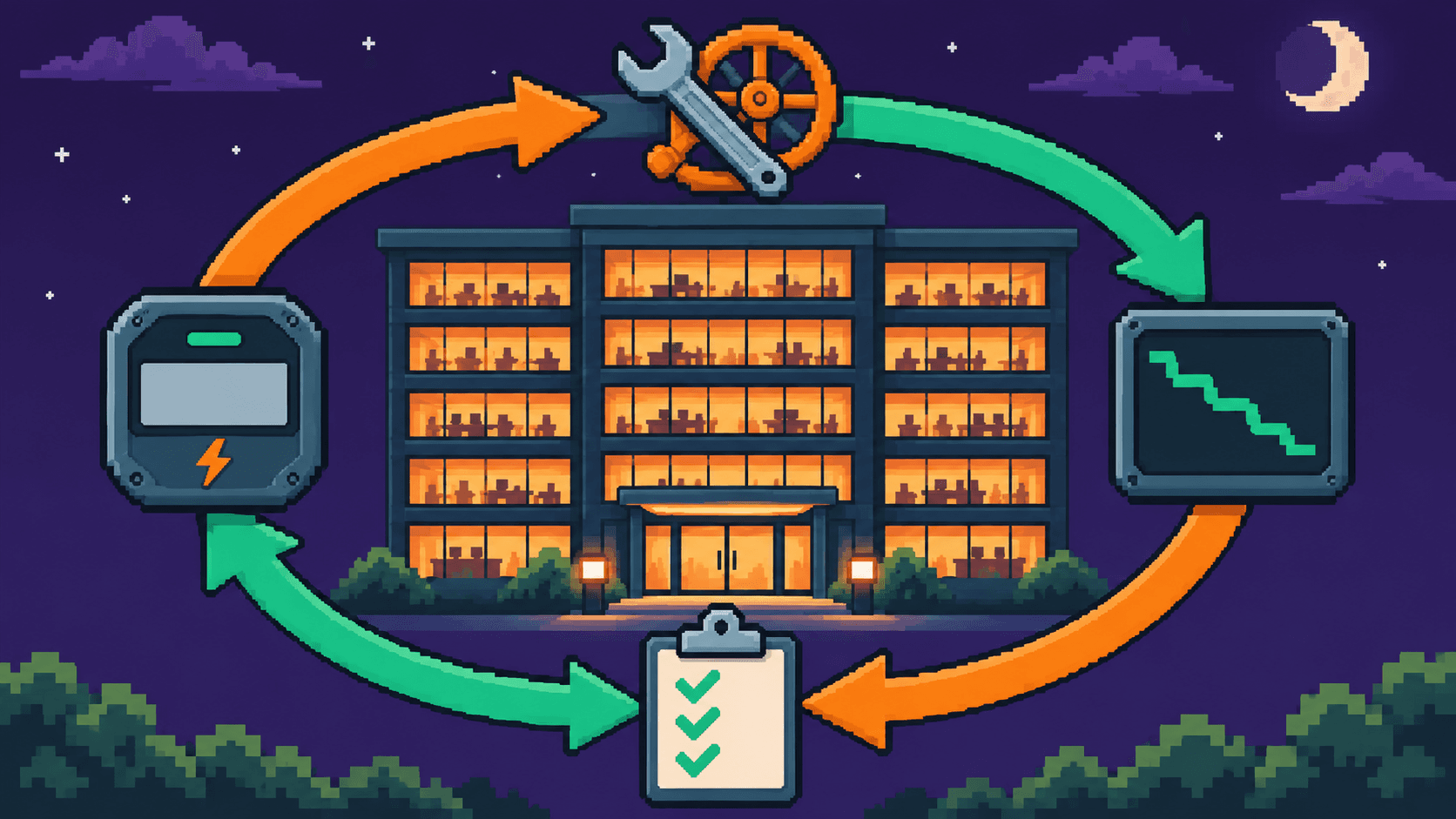
Energy management is a continuous improvement approach, not software: the approach (the EnMS), equipped with software (an EMS), which is only as good as its data (metering). Its goal is to improve the energy performance of each building, backed by measurement.
The energy management system (EnMS) provides its framework: policy, energy review, significant energy uses, EnPIs (energy performance indicators, IPÉ in French), energy baseline and action plan, in a PDCA cycle[2][2]StandardsISO, “ISO 50001:2018 Energy management systems”, requirements with guidance for useSee in sources ↓. We detail each building block of the energy management system in a dedicated article.
Management de l’énergie, gestion de l’énergie, energy management: are they the same thing?
Yes, in everyday use. Gestion de l’énergie, gestion énergétique, GTE (gestion technique énergétique, technical energy management): in French, these terms all refer to the same approach. The English term “energy management” comes mainly from software vendors, who sell energy management software under various names. The acronym on the quote matters less than what the system actually does.
Energy management depends first on people. The question is who drives it.
Energy manager, energy officer, building owner: who drives the approach?
In a large company, a full-time energy manager or head of energy drives the approach as project lead. Elsewhere, ADEME (the French agency for ecological transition) recommends appointing an energy officer[3][3]Bodies and institutionsADEME, “Système de management de l’énergie” (energy management system), recommendation to appoint an energy officerSee in sources ↓. Their background does not always include operating a BMS: check this before entrusting them with technical decisions.
The building owner, for its part, decides without in-house BMS expertise, on the advice of whoever will sell the works.
Energy audit or EnMS: what the consumption thresholds change
The Energy Efficiency Directive replaced company size with a consumption criterion[1][1]RegulationEuropean Parliament and Council of the European Union, “Directive (EU) 2023/1791 on energy efficiency”, Article 11 (thresholds of 85 TJ and 10 TJ), transposed into Article L. 233-1 of the French Energy Code (code de l’énergie) by Law No. 2025-391 of 30 April 2025 (thresholds of 23.6 GWh and 2.75 GWh)See in sources ↓. Above an average of 2.75 GWh per year (10 TJ in the European text), the energy audit had to be completed by 11 October 2026[1][1]RegulationEuropean Parliament and Council of the European Union, “Directive (EU) 2023/1791 on energy efficiency”, Article 11 (thresholds of 85 TJ and 10 TJ), transposed into Article L. 233-1 of the French Energy Code (code de l’énergie) by Law No. 2025-391 of 30 April 2025 (thresholds of 23.6 GWh and 2.75 GWh)See in sources ↓. Above 23.6 GWh, energy management (an EnMS) becomes mandatory on 11 October 2027[1][1]RegulationEuropean Parliament and Council of the European Union, “Directive (EU) 2023/1791 on energy efficiency”, Article 11 (thresholds of 85 TJ and 10 TJ), transposed into Article L. 233-1 of the French Energy Code (code de l’énergie) by Law No. 2025-391 of 30 April 2025 (thresholds of 23.6 GWh and 2.75 GWh)See in sources ↓. For a commercial property company, these two thresholds set a firm timetable to be met site by site.
Did you know? An SME that exceeds an average of 2.75 GWh per year, the threshold adopted by the French Energy Code, now falls within the scope of the audit, whatever its size[1][1]RegulationEuropean Parliament and Council of the European Union, “Directive (EU) 2023/1791 on energy efficiency”, Article 11 (thresholds of 85 TJ and 10 TJ), transposed into Article L. 233-1 of the French Energy Code (code de l’énergie) by Law No. 2025-391 of 30 April 2025 (thresholds of 23.6 GWh and 2.75 GWh)See in sources ↓. The European text no longer looks at headcount or turnover: only the kWh consumed count.
Do you need ISO 50001 certification?
Yes above 23.6 GWh per year: the directive then requires an EnMS certified by an independent body[1][1]RegulationEuropean Parliament and Council of the European Union, “Directive (EU) 2023/1791 on energy efficiency”, Article 11 (thresholds of 85 TJ and 10 TJ), transposed into Article L. 233-1 of the French Energy Code (code de l’énergie) by Law No. 2025-391 of 30 April 2025 (thresholds of 23.6 GWh and 2.75 GWh)See in sources ↓. Below that, certification remains voluntary. This international standard formalizes the energy management system and exempts the certified company from the regulatory audit[1][1]RegulationEuropean Parliament and Council of the European Union, “Directive (EU) 2023/1791 on energy efficiency”, Article 11 (thresholds of 85 TJ and 10 TJ), transposed into Article L. 233-1 of the French Energy Code (code de l’énergie) by Law No. 2025-391 of 30 April 2025 (thresholds of 23.6 GWh and 2.75 GWh)See in sources ↓.
Our reservation fits in one sentence: a certification is not a saving. It proves that an action plan exists and is reviewed. It does not say whether the BMS setpoints are being held.
Five regulatory frameworks the market confuses
Five texts overlap on the same commercial portfolio. The market mixes them up constantly: compliance, eligibility for a subsidy and performance end up on the same line of a quote. The table below separates them on what matters to a building owner: the trigger, the requirement, the deadline, the expected evidence and the blind spot of each framework.
| Framework | Trigger | Requirement | Deadline | Expected evidence | What the framework does not guarantee |
|---|---|---|---|---|---|
| Regulatory energy audit One-off snapshot |
More than 2.75 GWh consumed per year [1] | Audit of energy uses and costed recommendations | 11/10/2026 [1] | Audit report | That the recommendations are applied |
| Certified EnMS Continuous approach |
More than 23.6 GWh consumed per year [1] | Policy, energy review, EnPIs, action plan | 11/10/2027 [1] | Certificate from an independent body | A measured reduction in consumption |
| Éco Énergie Tertiaire scheme (Décret tertiaire) Reduction target |
Commercial buildings of 1,000 m² or more [4] | Reduction of 40%, 50% then 60% compared with a reference year [4] | Milestones 2030, 2040 and 2050 [4] | Annual declaration on OPERAT (the French government reporting platform) [4] | The reliability of the declared consumption |
| BACS decree No. 2020-887 Equipment obligation |
HVAC system above 70 kW [5] | Functional requirements, no automation class mandatory [5] | 1 January 2025 above 290 kW, 1 January 2030 from 70 to 290 kW [6] | Automation system installed | That setpoints hold after handover |
| CEE sheet BAT-TH-116 Subsidy, not compliance |
Installation or upgrade of a BMS in a commercial building | Automation class A or B [7] | When the application is filed | Proof of class | Compliance with the BACS decree |
Read the last column first. The BACS decree (French decree 2020-887 on building automation and control systems) does not make any automation class mandatory[4][4]RegulationFrench Republic, “Décret n° 2020-887 du 20 juillet 2020” on building automation and control systems in non-residential buildings and automatic heat regulation, codified in Articles R. 175-1 et seq. of the French Construction and Housing Code (code de la construction et de l’habitation), amended by Decree No. 2023-259 of 7 April 2023, LégifranceSee in sources ↓. CEE subsidies (CEE energy-savings certificates, certificats d’économies d’énergie), on the other hand, are only available for classes A or B[5][5]RegulationFrench ministry in charge of energy, “CEE standardized operation sheet BAT-TH-116”, building management system for heating, domestic hot water, cooling/air conditioning, lighting and auxiliaries in non-residential buildings, version A62-6 from the order (arrêté) of 30 August 2024, applicable to operations started since 1 January 2025See in sources ↓. A technical file often merges these two logics without saying so. Even once achieved, a class is not performance: it describes what a building can do, not what it does. The real environmental impact shows in measured energy consumption.
Setting up an energy management approach in 5 steps
1. Where to start on a portfolio already equipped with a BMS?
On an equipped portfolio, the setup starts with what the BMS already logs: points, meters, how long trend logs are stored. Next, list what actually comes through, site by site. The scope follows: which assets, which uses, which meters. Finally, appoint an energy officer, with dedicated time rather than one more line in their job description. The metering data that matter are detailed in what data for an EMS.
2. Energy review and energy baseline
The energy review identifies the significant energy uses: in an office building, almost always HVAC. It relies on an analysis of consumption by use. Then comes the energy baseline, corrected for heating degree days (HDD, called DJU in France), against which all energy performance will be judged. An energy audit feeds this review without replacing it: the audit takes a snapshot, the review is kept up to date.
3. EnPIs, objectives and action plan
EnPIs translate the energy policy into quantified objectives, for example kWh per m² corrected for HDD. The roadmap breaks these objectives down into an action plan, driven by a named project lead. Return on investment varies widely: on small commercial sites, an acceptable payback period remains hard to achieve. CEE subsidies can then weigh in the financing[5][5]RegulationFrench ministry in charge of energy, “CEE standardized operation sheet BAT-TH-116”, building management system for heating, domestic hot water, cooling/air conditioning, lighting and auxiliaries in non-residential buildings, version A62-6 from the order (arrêté) of 30 August 2024, applicable to operations started since 1 January 2025See in sources ↓.
4. Implementing actions all the way down to the controllers
An action is implemented where it actually runs: setpoints, time schedules, BMS sequences. These levers require neither installation nor equipment replacement, unlike CAPEX. The classic technical trap: the action that stays in the spreadsheet and never reaches the controller.
A spreadsheet never lowered a setpoint.
From meter to BMS: where energy management breaks down
From meter to energy review: the five-link chain
An energy review is only as good as the measurement that feeds it. Between the meter and the management review, the energy management chain passes through five pieces of equipment or technical layers. The diagram below lines them up: for each link, the failure we encounter most often and the test that reveals it. Select a link to see what it contaminates downstream.
Five links, five failures, five tests
Each link passes its errors on to the next. The EnPI presented at the management review inherits everything that broke upstream. Scroll the chain to the right →Read it from right to left, as a management review does: the EnPI inherits every error made upstream. Most often, the link that breaks is neither the meter nor the monitoring platform. It is the supervision system, where a manual override set on a Friday evening stays active for months. No reporting system sees it until someone goes and extracts it.
Data gaps and duplicate meters: when the EnPI is calculated on false data
The scene is a classic on a portfolio of head offices: 500 meters and nobody knows which ones are reliable. Some have been disconnected since the last supervision update. Others count the same AHU twice, at the outgoing feeder and at the sub-distribution board.
The EnPI stays smooth. That is precisely the trap. An interpolated storage gap erases real consumption. A slow drift, meanwhile, stays below the alert threshold. Serious energy monitoring qualifies each reading before calculating any energy performance.
Manual overrides and drifting setpoints: energy drift
In a new or renovated building, energy drift sets in patch after patch. A VIP complaint gets a setpoint raised (the top-floor director who demands 24-25 °C all year round, seen many times).
A faulty sensor then switches an AHU into degraded mode that nobody puts back into automatic. The manual override set as a quick fix is never released. With nothing put back into automatic, the HQE-certified building (HQE: French green building certification) drifts away from its design consumption. Yet the technical lever lies in the controllers.
Suspect a BMS that no longer holds its setpoints? We list the active manual overrides and drifted setpoints before putting a figure on anything.
The remaining question is which tool detects these drifts and which one corrects them.
Do you need energy management software?
Platform, EMS, software: the same thing, three words. On a few sites with clean metering, a well-kept spreadsheet is enough for the energy review. Beyond that, an energy management platform automates data collection and HDD correction. To choose energy management software, start from the actual state of your company’s metering. The free or paid EMS debate comes next. No energy management solution fixes a faulty meter.
What is the difference between an EMS and a BMS?
The split of roles fits in one sentence: the EMS detects the drift, the BMS corrects it. The EMS collects, normalizes and alerts without ever acting on equipment. The BMS controls valves, AHUs and schedules. The hypervisor aggregates several sites and several supervision brands. The link between these three layers is detailed in EMS, BMS and hypervisor.
An alert never closed a valve.
Is an EMS enough for energy management?
No. An energy management system equips the approach without replacing it: you also need a roadmap, qualified metering and action in the controllers. An EMS that does not write to the BMS remains a dashboard. Before buying one, check how to connect an EMS to the BMS on your portfolio. Then write this write-access requirement into your EMS specification.
What energy management delivers when the chain holds
Seven questions for the provider announcing a saving
Energy savings measured rather than promised
A saving only counts if it is measured according to the IPMVP protocol. It only holds if it rests on an energy baseline corrected for HDD. Double-digit ranges announced without a protocol say nothing about your bill.
An asset’s potential is quantified after examination, on its real trend logs rather than on ADEME ranges. Comfort remains a constraint, never an adjustment variable. On a small site, it is therefore better to start with the no-works levers, which sit in the BMS setpoints.
Lower greenhouse gas emissions in the carbon footprint
Each kWh avoided converts into tCO2e in the carbon footprint, using the emission factor of the energy concerned. An organization that documents its savings feeds its low-carbon trajectory with readings rather than commitments. A reduction commitment presented to the board of directors can thus be verified, reading after reading.
Make it reliable first, optimize second: what Foobot does on your BMS
BMS advisory: making meters reliable and releasing manual overrides
Our BMS advisory is a service in its own right: each engagement puts the installation back in order, with no mandatory AI phase afterwards.
- Making meters reliable, gaps and duplicates included
- Operations advisory: manual overrides released, consistent sequences
- Second opinion on a BMS declared obsolete
- Handover and warranty year (defects liability period) tested under real conditions
Many portfolios stop there. It is often enough.
AI Control: adjusting HVAC every 15 minutes when complexity justifies it
When thermal inertia, solar gain and occupancy make control genuinely complex, AI Control takes over. We train a digital twin specific to each asset on the BMS trend logs, weather and occupancy. The method follows three stages: examine the BMS, learn in the twin, control.
This technology adjusts water loops, air flow rates and supply air every 15 minutes, 24/7, with no works. Savings are measured according to IPMVP with HDD correction. The contract runs for 12 months.
Energy management is won in the BMS as much as in the management review
A certified approach guarantees nothing if the chain breaks between the meter and the controller. Energy management stands on four supports: an honest review, qualified metering, actions written into the setpoints and savings measured according to a protocol. Start with the least spectacular lever: export your trend logs and count your reliable meters. Setting up a tool comes afterwards, sized on what you have found. Our EMS is free. It does neither portfolio ESG reporting nor multi-country. To track your drifts month on month, corrected for HDD, open it right now.
FAQ - energy management
What is the ISO 50001 standard?
It is the international standard that defines the energy management system: policy, energy review, EnPIs, energy baseline and action plan in a PDCA cycle[2][2]StandardsISO, “ISO 50001:2018 Energy management systems”, requirements with guidance for useSee in sources ↓. Revised in 2018, it is certified by an independent body.
Difference between ISO 14001 and ISO 50001?
The first covers an organization’s overall environmental impact: waste, discharges, greenhouse gases. The second is limited to energy and requires quantified performance indicators. The two are often integrated into a single management system.
Do you need an energy manager to launch a solar project?
Not necessarily. You do, however, need to know actual consumption, hour by hour, before sizing a solar photovoltaic plant or storage. Without reliable metering, renewable production is poorly calibrated and the low-carbon balance ends up overestimated.
Difference between an energy audit and an EnMS?
The first is a one-off snapshot of consumption and savings opportunities. The EnMS is a continuous approach, with policy, objectives, actions and management review. A company with a certified EnMS is exempt from the regulatory audit[1][1]RegulationEuropean Parliament and Council of the European Union, “Directive (EU) 2023/1791 on energy efficiency”, Article 11 (thresholds of 85 TJ and 10 TJ), transposed into Article L. 233-1 of the French Energy Code (code de l’énergie) by Law No. 2025-391 of 30 April 2025 (thresholds of 23.6 GWh and 2.75 GWh)See in sources ↓.
What are the main steps for implementing an energy management system in the commercial building sector?
The setup follows five stages: start from what the BMS logs, conduct the energy review, set EnPIs and objectives, act in the controllers, then measure according to IPMVP before starting the cycle again.
In-house or outsourced?
A full-time position is justified on a large multi-site portfolio. Elsewhere, an energy officer appointed in-house, as recommended by ADEME[3][3]Bodies and institutionsADEME, “Système de management de l’énergie” (energy management system), recommendation to appoint an energy officerSee in sources ↓, can steer assignments entrusted to specialists. Keep the decision-making and access to the trend logs in-house.
What tools for energy management?
Three families coexist. The EMS collects, normalizes and alerts. The BMS acts on HVAC equipment. The hypervisor aggregates several sites and several supervision brands. The right combination depends on the number of assets and the quality of the existing metering.
How do you train an energy officer?
Professional training courses prepare for the role of energy manager or energy management officer, such as the 21-hour TÜV course, reference FR-EV12[6][6]Bodies and institutionsTÜV Rheinland Académie, “Responsable du management de l’énergie (TÜV)” (energy management officer), 21 hours in person, reference FR-EV12See in sources ↓. These programs say little about BMS: complement them with field experience, with the supervision system open.
Sources and references
6 sources.- [1]European Parliament and Council of the European Union, “Directive (EU) 2023/1791 on energy efficiency”, Article 11 (thresholds of 85 TJ and 10 TJ), transposed into Article L. 233-1 of the French Energy Code (code de l’énergie) by Law No. 2025-391 of 30 April 2025 (thresholds of 23.6 GWh and 2.75 GWh)13 September 2023↑ 1 2 3 4 5 6 7 8
- [4]French Republic, “Décret n° 2020-887 du 20 juillet 2020” on building automation and control systems in non-residential buildings and automatic heat regulation, codified in Articles R. 175-1 et seq. of the French Construction and Housing Code (code de la construction et de l’habitation), amended by Decree No. 2023-259 of 7 April 2023, Légifrance20 July 2020↑
- [5]French ministry in charge of energy, “CEE standardized operation sheet BAT-TH-116”, building management system for heating, domestic hot water, cooling/air conditioning, lighting and auxiliaries in non-residential buildings, version A62-6 from the order (arrêté) of 30 August 2024, applicable to operations started since 1 January 2025↑ 1 2