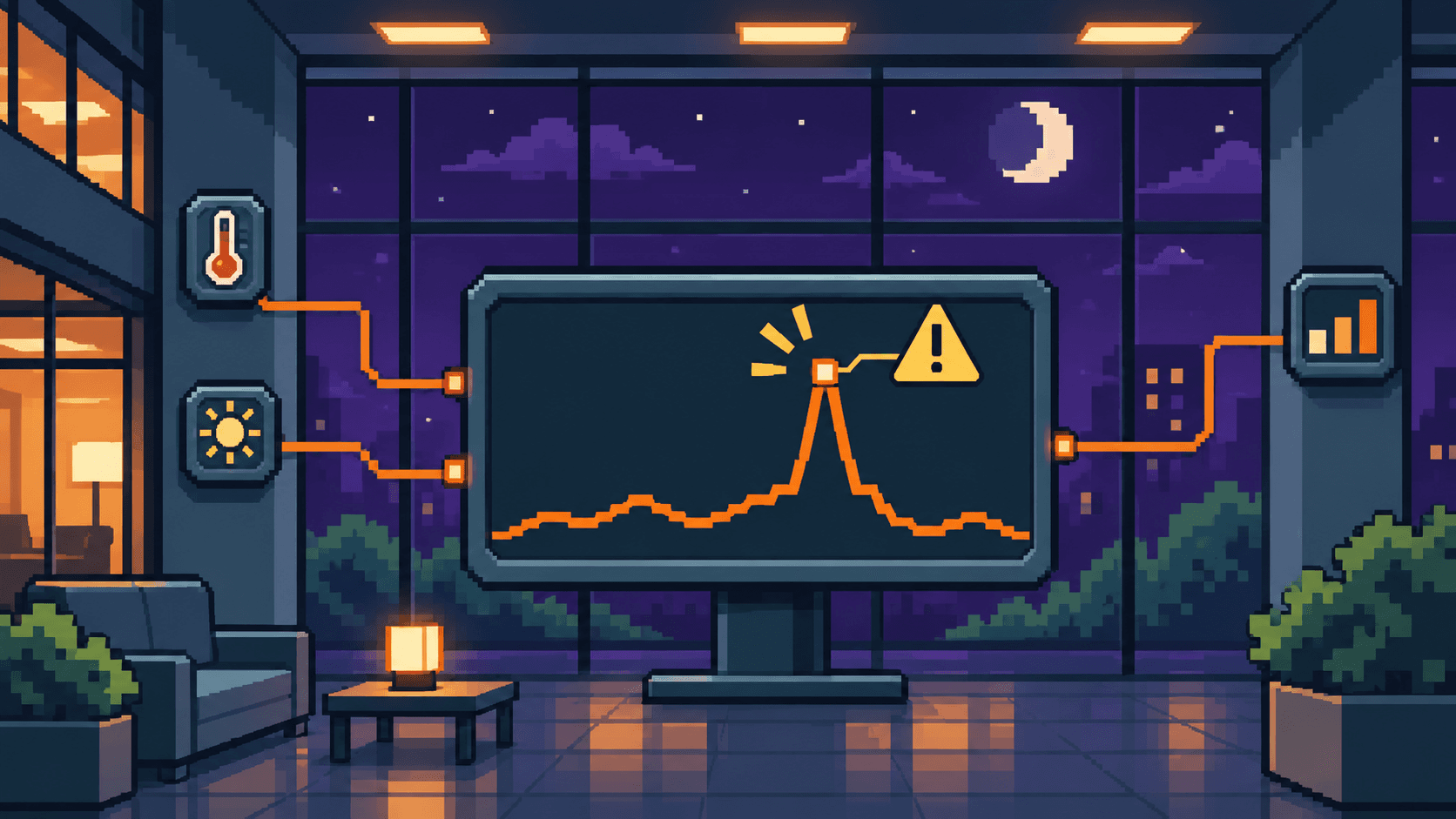
You sign up for control. You get a screen. An energy management system (EMS) reads the energy consumption of your commercial building without touching a single valve. The rule fits in one sentence: an EMS reads and alerts, the BMS acts. This energy management tool is only as good as its data. Here is what you need to decide before signing: what such a solution does, where it stops and how to prove an energy saving on each of the company's sites.
What is an energy management system and where does it stop?
Definition: software that reads, normalizes and alerts
An energy management system (EMS) is management software that collects data from the meters and from the BMS (building management system). It normalizes them by heating degree days (HDD, called DJU in France), detects drifts, triggers alerts and produces reporting. This monitoring tool makes energy efficiency readable and shows the energy manager where costs are slipping. It controls no equipment: the action still has to be taken on the building.
The French market also says GTE, for gestion technique énergétique (technical energy management). Platform, EMS or EMS software: the same thing, three words.
On brochures, you will still read energy management software. In every case, the tool equips energy management, which remains a continual improvement approach. No system runs it for you.
Building, power grid, charging stations: the three meanings of the acronym
The acronym covers three realities. On a power grid or a site supplied by renewable energy sources, energy management systems arbitrate between solar production, battery charging (energy storage) and drawing power from the grid.
For EV charging stations, the same technology shares the available power between vehicles. This article only keeps the first meaning: the energy consumed by the commercial building.
Who uses an EMS in a commercial portfolio
Four profiles open the tool in a commercial real-estate organization. The real-estate department looks for what it needs to decide on an investment. The energy manager wants to see the drift before the bill. The operator tracks down the site whose consumption no longer matches occupancy hours. The CSR team draws on it to back up the company's energy reporting.
Offices, care homes, hospitals or industrial sites: each one thinks it is buying a different answer from the same screen. What remains is to see what this screen really gives them.
EMS and EnMS: the tool and the ISO 50001 approach
The EnMS, or energy management system in the ISO 50001 sense (called SMÉ in France), is a continual improvement approach. The EMS is the tool that equips it with measurements. The approach sets the objective and the action plan.
Its reference framework is the ISO 50001 standard, published in 2011 and revised in 2018[1][1]Standards and protocolsISO, “ISO 50001:2018, Energy management systems”, revision of the edition published in 2011See in sources ↓. The European Energy Efficiency Directive requires a certified EnMS from companies whose average annual consumption exceeds 85 TJ. France's DDADUE law of 30 April 2025 (a law adapting French law to EU law) transposes it with a threshold of 23.6 GWh[2][2]RegulationEuropean Union, “Directive (EU) 2023/1791 on energy efficiency”, 85 TJ average annual consumption threshold for the certification of an energy management systemSee in sources ↓[3][3]Press and announcementsAkéa Énergies, “Energy management”, obligation threshold for a certified EnMS at around 23.6 GWh of annual consumptionSee in sources ↓.
The obligation targets the approach, not a piece of software. An ISO certification cannot be bought with a subscription: our page on the energy management system (EnMS) details its components.
EMS and BMS: what is the difference?
The BMS, called building automation and control system (BACS) in regulatory texts, acts on equipment. It opens a valve, shifts a setpoint, stops an air handling unit (AHU). An EMS that does not write to it remains a dashboard, in other words a monitoring tool.
The EMS detects the drift, the BMS corrects it.
The BACS decree (French decree 2020-887 on building automation and control systems) applies to the BMS, never to the EMS. Commercial buildings whose heating or air-conditioning system exceeds 290 kW of rated output have had to be equipped since 1 January 2025[4][4]RegulationLégifrance, “Decree No. 2020-887 of 20 July 2020 on building automation and control systems in non-residential buildings and automatic heat regulation”, codified in articles R. 175-2 and R. 175-3 of the French Construction and Housing Code (Code de la construction et de l'habitation), obligation for buildings above 290 kW and functional requirements with no mandatory classSee in sources ↓. For existing buildings in the 70-290 kW bracket, the deadline has been postponed from 1 January 2027 to 1 January 2030[5][5]RegulationLégifrance, “Decree No. 2025-1343 of 26 December 2025 amending the application dates of the obligations concerning building automation and control systems in commercial buildings, temperature regulation systems for heating and cooling systems and the insulation of heating and cooling distribution networks”, postponement for existing buildings in the 70-290 kW bracket from 1 January 2027 to 1 January 2030See in sources ↓.
EMS, BMS, BEMS: what are the differences?
BMS, short for building management system, refers to the building automation system itself (called GTB in France). The building energy management system (BEMS) is the EMS applied to a building, on the consumption-reading side. The hypervisor, for its part, aggregates several buildings and several BMS brands: it is neither an EMS nor a BMS.
We detail the split of roles on our page EMS, BMS and hypervisor.
From sensor to reporting: where each system stops
Here, system by system, is what each one reads, decides and physically controls. The highlighted row is the one that matters for your purchase. Remember it: the EMS acts on no equipment. It can only act through the BMS, and only if it has write access. Turn on the table filter: only one row stays lit.
What each system reads, decides and controls
Read the “equipment physically controlled” column: it is what separates a screen from a tool that acts.| System | Data read | Decisions made | Equipment physically controlled | Applicable regulation | Day-to-day owner |
|---|---|---|---|---|---|
| EMS software (GTE / BEMS)Reads and alerts | Meter readings, BMS trend-logged points, HDD. | None on equipment. It detects drifts and triggers alerts. | None, except through the BMS if it has write access. | No regulation requires it. It documents the reporting under the Décret tertiaire (France's tertiary decree on energy savings in commercial buildings). | Energy manager or head of energy. |
| ISO 50001 EnMSApproach | Energy review, EnPIs (energy performance indicators), records produced by the EMS. | Energy policy, objectives, action plan. | None: it is an organization, not a technical system. | DDADUE law, ISO 50001 standard. | Senior management, with the energy manager leading the approach. |
| BMSActs | Temperature, occupancy and flow sensors, statuses, alarms. | Setpoints, schedules, control sequences. | Boilers, chillers, AHUs, valves. | BACS decree No. 2020-887. | Operator and maintenance contractor. |
| HypervisorAggregates | Several buildings and several BMS brands. | Consolidates, compares and alerts at portfolio level. | None directly. | No regulation. | Real-estate department or multi-building operator. |
| For reference: grid or renewable-site EMSOutside the building | Solar production, battery charging, grid draw. | Arbitrates between production, storage and grid draw. | Batteries and inverters of the production site. | Outside the scope of this article. | Production site operator. |
Before signing, ask the vendor which row of this table its tool really occupies. If it claims to control, demand proof: which protocol, which points in write mode, which setpoint already tested on your BMS.
What an EMS does and does not do for energy consumption
Collecting and normalizing consumption data
The EMS collects meter readings and the BMS trend-logged points. Raw, this energy data says nothing. Comparing it month against month, corrected for HDD (heating degree days), avoids mistaking a cold winter for a drift.
Everything starts at the metering panel. A mislabeled feeder distorts the consumption profile. No analysis, even one that accounts for weather and occupancy, can make up for a wrong measurement.
Detecting drifts and triggering alerts
Once the data is normalized, the load profile makes the energy drift visible from year to year. A night-time consumption peak jumps out. An AHU that overconsumes day after day ends up triggering the filter-change alert, with weeks of energy waste on the meter.
Manual overrides left in place after a VIP complaint also show up, almost in real time. This part falls under energy monitoring: the EMS reports, it does not correct.
Artificial intelligence: what prediction really changes
The market is happy to sell “smart energy management systems”. Yet artificial intelligence, a fashionable technology, is only justified in the face of real complexity: thermal inertia, solar gain, variable occupancy. For lighting, an occupancy sensor is enough.
Engineers (ourselves included) readily forget one detail: predicting is useless if the BMS does not execute. Calculating the right setpoint without being able to write it helps no one optimize consumption.
Does an EMS save energy on its own?
No. Connected to doubtful metering and a BMS running in degraded mode, an EMS only sees distorted symptoms.
It then remains an expensive rear-view mirror. Savings come from action on equipment: a setpoint corrected by the BMS, a schedule reset by the operator. The tool points to energy waste without eliminating it. To cut costs, the real need lies in the chain that executes.
Implementing an EMS in a commercial building in five steps
Step 1: inventory the meters, BMS points and tools in place
Before any software, you need to know what measures what. This inventory comes before implementation and often reveals a metering plan never updated since handover:
- main meters and sub-meters
- BMS sensors: temperature, occupancy, flow
- controllers, small industrial computers without a screen
- supervision and trend logging of data
- management or reporting software already in place
Any equipment or tool missing from this inventory will remain invisible in the EMS.
Step 2: make the data reliable before connecting the tool
An EMS running on wrong data produces wrong alerts. Before comparing quotes, screen your portfolio for seven defects we find in the field. They range from disconnected meters to manual overrides that distort the consumption profile. The checklist below asks the only question that matters: does your data deserve an EMS?
Does your data deserve an EMS?
For each defect, answer for your portfolio. “I don't know” is already an answer: a defect you cannot check weighs almost as much as a confirmed one.- Which meters and which BMS points does the tool actually read today?
- Who deals with history gaps and duplicates before commissioning?
- On which points does the tool write to the BMS, in BACnet or LON?
If the verdict leans towards making the data reliable, start there. Dealing with history gaps and duplicates is better than paying for a subscription that monitors silent meters.
Step 3: choose the tool, its hosting and its access to the BMS
Three trade-offs weigh more than the interface. Hosting, in the cloud or on premises, has implications for data security. The second point, integration with the BMS, settles everything: read-only or write access, via BACnet or LON. A read-only EMS will never change a setpoint.
Finally, the specification states what the tool must control, not just display.
Step 4: set the baseline and the action plan
The energy baseline, the energy performance indicators (EnPIs) and the action plan are components of the EnMS described by ISO 50001[1][1]Standards and protocolsISO, “ISO 50001:2018, Energy management systems”, revision of the edition published in 2011See in sources ↓. Here, the baseline sets the energy starting point, on a reliable history linked to significant energy uses. Each action builds on it, with its objective, its owner and its implementation date. Without this written energy strategy, the EMS piles up alerts that no one handles.
What remains is to check that the tool can make the BMS act.
Step 5: start with a pilot building, then roll out across the portfolio
Choose a representative asset, an office building or an industrial site. First check data upload, point by point. Then test the move that matters: a setpoint written by the tool, executed by the BMS and observed on the equipment. This test takes a little time. It avoids discovering the lack of write access after rollout across the whole portfolio.
Benefits of an EMS: costs, carbon, compliance and proof of energy savings through IPMVP
Cutting costs by tracking down energy waste
An EMS does not lower any bill by its mere presence. Its benefit lies in what it makes visible. It shows the AHU running at weekends, the setpoint left at 24 °C and the override set after a complaint and never lifted. Every saving rests on an action actually carried out on a piece of equipment. Energy efficiency is won in the plant room, not on the dashboard.
No action on the equipment, no cost reduction.
Carbon footprint: carbon follows the energy actually avoided
Avoided tCO2e are derived from avoided kWh, measured and attributed to a specific action. An EMS only reduces the carbon footprint through the corrections it triggers on the BMS or with the operator. Without verified kWh, the greenhouse gas emissions balance only moves on paper.
Décret tertiaire and ISO 50001: documenting the trajectory
The Décret tertiaire requires annual consumption reporting on the OPERAT platform (the French government platform for collecting this data). It also sets a reduction trajectory with milestones in 2030, 2040 and 2050[6][6]RegulationLégifrance, “Decree No. 2019-771 of 23 July 2019 on the obligations to reduce final energy consumption in commercial buildings” (Éco Énergie Tertiaire scheme, known as the Décret tertiaire), annual reporting on OPERAT and 2030, 2040 and 2050 milestonesSee in sources ↓. The EMS provides the energy data for this reporting, asset by asset, with the history needed to defend it. For a company pursuing ISO 50001 certification, it serves as a framework for documentary evidence. The energy management system requires records: the tool produces them.
Did you know? Contrary to the dominant reading in the market, the BACS decree does not impose any class of NF EN ISO 52120-1[4][4]RegulationLégifrance, “Decree No. 2020-887 of 20 July 2020 on building automation and control systems in non-residential buildings and automatic heat regulation”, codified in articles R. 175-2 and R. 175-3 of the French Construction and Housing Code (Code de la construction et de l'habitation), obligation for buildings above 290 kW and functional requirements with no mandatory classSee in sources ↓. It sets its own functional requirements, such as hourly monitoring of consumption by zone and interoperability with technical systems. The class of a BMS and its compliance with the decree remain two separate questions.
Why is a displayed saving not a measured saving?
A mild winter, a floor vacated by a tenant, more remote working: each of these events lowers the bill without anyone touching a setpoint. Yet the saving shows up in green on the dashboard. It ends up in the executive committee as a real saving, then in the environmental impact report. No one corrected anything.
A displayed saving is not a measured saving.
HDD-adjusted baseline: separating weather from action
The HDD-adjusted baseline recalculates what the building would have consumed without any action, with the actual weather of each month. The curve below isolates three elements: the corrected baseline consumption, the consumption measured after the action and the gap actually attributable to that action. Switch from raw saving to adjusted saving: you will see the weather's share melt away.
Raw saving or HDD-adjusted saving: what the weather does for you
- Consumption measured after action
- Gap counted as a saving
- Mild February
The mild month flagged in yellow inflates the raw saving without operations having anything to do with it. Once the analysis takes HDD into account, the gap narrows. It then becomes defensible before a third party. The rule fits in one sentence: no adjusted baseline, no saving.
IPMVP protocol: three questions to ask before believing a figure
The IPMVP protocol (International Performance Measurement and Verification Protocol) frames the verification process around three questions. First ask which reference period was used to build the baseline and whether it covers all seasons. Then check the adjustment variables: HDD, which reflect heating demand, then occupancy when it has changed. Finally, find out who verifies. A saving checked by a third party carries weight in an action plan and in a return-on-investment calculation. A self-certified saving carries much less.
What a serious measurement shows: the Valeo case
At Valeo, we measured −28.6% HVAC consumption under the IPMVP protocol. This result holds because it is tied to an identified asset, an adjusted baseline and a possible third-party verification. It promises nothing for your portfolio. The achievable energy efficiency, like the carbon impact avoided, can be quantified after an energy audit, on your actual historical data.
What Foobot brings around an energy management system
BMS advisory: making meters and BMS reliable before any dashboard
Our BMS advisory starts with what is rarely checked before buying an EMS: metering. We track down disconnections, data gaps, duplicates and invisible drifts. We then remove the overrides that distort day-to-day management. This reliability work stands on its own, with no AI phase behind it. It serves Procurement, Works and Operations, who need to decide on accurate figures.
AI Control: moving from alert to HVAC control
AI Control is aimed at real-estate departments. We train a digital twin of each building on its BMS history, the weather and occupancy. This artificial intelligence predicts energy demand and adjusts the HVAC setpoints.
Control runs every 15 minutes, 24/7, through the existing BMS in BACnet or LON, without any works. The contract runs for 12 months, with savings in consumption and greenhouse gas emissions measured under IPMVP.
AI Optimal Start: starting each zone at the right time
AI Optimal Start is designed for FMs and operators. Every day, the AI recalculates the start time of each zone based on its thermal inertia, the weather and expected occupancy. It replaces the reactive global optimal start, which starts all zones at the same time and creates a consumption peak early in the morning. Neither too early nor too late.
An EMS is only worth as much as its data and the BMS that listens to it
An EMS creates no savings: it reveals the ones still to be captured. Its data still has to tell the truth, and the BMS still has to act on what it detects. The order is not up for debate: make reliable, make the BMS act, measure. Skipping the first step means paying for a tool to monitor silent measurements.
This article gives you the questions to ask before signing a quote. To start on your own historical data, request a quote: we begin by making your metering and your BMS reliable, asset by asset.
FAQ - energy management system
What does EMS mean?
An energy management system (EMS) has three meanings. In buildings, it monitors consumption. On a power grid, it arbitrates between solar production, energy storage and renewable energy sources. For charging stations, it shares out the power. Here we cover buildings.
What do SME / SMÉ / SMEn mean?
These three French acronyms refer to the système de management de l'énergie, the energy management system (EnMS), a continual improvement approach in the ISO 50001 sense[1][1]Standards and protocolsISO, “ISO 50001:2018, Energy management systems”, revision of the edition published in 2011See in sources ↓. The EnMS organizes the policy, energy review, EnPIs and action plan. The EMS is the software that equips this approach.
Which equipment can an EMS control?
None directly. EMS software reads and alerts: it does not command boilers, chillers or AHUs. If it has write access to the BMS, it sends setpoints to it. It is then the BMS that controls each piece of equipment.
Is it compatible with ISO 50001 certification?
An EMS is compatible with ISO 50001 certification and often makes it easier. The ISO standard requires measured consumption, tracked EnPIs and up-to-date records. The tool produces them. Certification, however, covers the approach, never the software.
What are the main steps in implementing an energy management system in the commercial sector?
Five steps follow one another: inventory the metering and BMS points, make the data reliable, choose the tool and its access to the BMS, set the baseline, then test a pilot asset before rollout across the portfolio.
How can I identify the best technology solutions to reduce my company's carbon footprint?
Test criteria rather than brochures. Does the technology write to the BMS? Do the savings rely on an HDD-adjusted baseline? Does a third party verify them? A sustainable solution reduces the carbon footprint and environmental impact through measured kWh.
What tools are needed for an EMS?
Three building blocks are enough: reliable, documented metering, trend-logged BMS points and management software that collects, normalizes and alerts. Without accurate measurements, the best monitoring tool produces false alerts that no one handles.
Do you need a BMS to have an EMS?
No to read, yes to act. An EMS can run on metering data alone and flag a drift. Without a BMS, every correction relies on manual intervention by the operator. The tool then remains a dashboard, useful but limited.
Is there such a thing as a free EMS?
Yes, in several forms: a spreadsheet filled in by hand or tools with no subscription. Their purchase cost is zero, but not their operating cost. Common limits: no portfolio ESG reporting and no software that writes to the BMS.
Sources and references
6 sources.- [2]European Union, “Directive (EU) 2023/1791 on energy efficiency”, 85 TJ average annual consumption threshold for the certification of an energy management system13 September 2023↑
- [4]Légifrance, “Decree No. 2020-887 of 20 July 2020 on building automation and control systems in non-residential buildings and automatic heat regulation”, codified in articles R. 175-2 and R. 175-3 of the French Construction and Housing Code (Code de la construction et de l'habitation), obligation for buildings above 290 kW and functional requirements with no mandatory class20 July 2020↑ 1 2
- [5]Légifrance, “Decree No. 2025-1343 of 26 December 2025 amending the application dates of the obligations concerning building automation and control systems in commercial buildings, temperature regulation systems for heating and cooling systems and the insulation of heating and cooling distribution networks”, postponement for existing buildings in the 70-290 kW bracket from 1 January 2027 to 1 January 203026 December 2025↑
- [6]Légifrance, “Decree No. 2019-771 of 23 July 2019 on the obligations to reduce final energy consumption in commercial buildings” (Éco Énergie Tertiaire scheme, known as the Décret tertiaire), annual reporting on OPERAT and 2030, 2040 and 2050 milestones23 July 2019↑