For once, we are going to talk about outdoor air quality - we spend most of our time indoors, but outdoor air quality also matters for many reasons. Building ventilation systems draw in outside air to renew indoor air, and of course we are exposed whenever we commute or go for a walk. It is nothing new that outdoor air pollution has been linked to a range of negative consequences, such as an increase in respiratory diseases as well as climate change. This article aims to explain why hot summer weather affects pollution.
Quick navigation
- How heat waves cause air pollution spikes
- Ozone
- Particulate matter
- Why air pollution causes global warming
- The role of temperature inversions
- What concentrations of ozone and fine particulate matter are considered acceptable?
- How to fight ozone and fine particulate matter pollution
- Recent examples of pollution spikes caused by heat waves
- Conclusion
Although outdoor air pollution is largely the result of human activity, pollutant concentrations are not constant and depend on various factors. Some pollutants, such as nitrogen oxides (NOx) and sulfur oxides (SOx), are produced directly by vehicles, power plants and other combustion equipment. Ground-level ozone (O3), on the other hand, is not emitted directly but is actually the result of chemical reactions in the atmosphere. Particulate matter (PM) can either be emitted directly or formed from other pollutants through chemical reactions.
As you may remember from your science textbooks, high temperature speeds up the rate of chemical reactions, which means that the concentration of ozone tends to increase[1] during heat waves, along with the amount of PM formed from other pollutants.
How heat waves cause air pollution spikes
To understand how heat waves degrade outdoor air quality, it is necessary to review the formation process of two key pollutants: fine particulate matter and ozone.
Ozone
Ozone can be either good or bad for human health depending on how high it is in the atmosphere. In the upper atmosphere, ozone plays a key role in blocking harmful solar radiation; however, it has many negative consequences for human health when we breathe it at ground level, including:
- Shortness of breath
- Difficulty breathing
- Coughing
- Throat irritation and inflammation of the airways
- Worsening of the symptoms of pre-existing conditions such as asthma and bronchitis.
Beyond its medical consequences, ozone also has an economic impact. People suffering from the symptoms above become less productive at work, or may even be forced to take sick leave.
The formation of ground-level ozone requires four key ingredients: nitrogen oxides (NOx), volatile organic compounds (VOCs), heat and sunlight. The first two are emitted directly by human activity, while the last two depend on the weather; as a result, outdoor air quality can be expected to worsen with high temperature, and especially on hot, cloudless summer days, when there is also an abundance of sunlight.
How it works
In general, nitrogen oxides and VOCs supply extra oxygen atoms that combine with atmospheric oxygen (O2) to form ozone (O3). The following reaction explains how ozone can form[2] from nitrogen dioxide (NO2):
NO2 + sunlight = NO + O
O + O2 = O3
This is a very simple example. Most of the reactions that form ozone from NOx and VOCs are far more complex and involve several intermediate steps.
Particulate matter
Particulate matter can be either emitted or formed. Formation becomes faster with heat. PM is considered primary when it is emitted directly by combustion, and secondary when it is produced by the chemical reaction of other air pollutants. Specifically, the concentration of secondary PM increases during heat waves, since the reactions that lead to its formation are accelerated, just as in the case of ozone. Nitrogen oxides (NOx), ammonia (NH3), sulfur oxides (SOx) and volatile organic compounds have been identified as reactants that contribute to the formation of secondary particulate matter. Accordingly, here are the 3 main types of secondary PM:
1
NITRATES
Nitrogen oxides or ammonia can react to form nitrates, which gather as solid particles suspended in the air. In other words, solid pollutants (PM) can come from gaseous pollutants.
2
SULFATES
Sulfur oxides lead to the formation of sulfates, which are also solid.
3
SECONDARY ORGANIC COMPOUNDS
VOCs can react to form larger hydrocarbon molecules, which remain suspended in the air in solid form. Just like nitrates and sulfates, these solid organic molecules can aggregate into larger particles that are considered particulate matter.
When high temperatures coincide with periods of high atmospheric pressure, ozone and particulate matter can reach dangerously high levels. While high temperature leads to faster formation of ozone and fine particulate matter, high pressure makes it difficult for natural air currents to disperse these pollutants. Precipitation is generally beneficial for air quality, because airborne particulate matter sticks to water droplets and falls to the ground.
Why air pollution causes global warming
Air pollution and global warming interact with each other and reinforce one another: just as high temperature causes spikes in the concentration of certain pollutants, air pollution itself also leads to higher temperatures. Therefore, climate change and air pollution can be addressed more effectively together[3] than separately.
By itself, high temperature is not a direct cause of air pollution, but it accelerates the reactions that form key pollutants such as ozone and secondary particulate matter. Human activity is the main source of reactants, especially the use of fossil fuels; burning them releases nitrogen and sulfur oxides, as well as volatile organic compounds.
Many compounds emitted by human activity, and their by-products, can trap solar radiation in the Earth's atmosphere that would normally be reflected back into space. The following substances have been identified as key drivers of global warming by retaining heat in the atmosphere:
- Carbon dioxide
- Methane
- Nitrous oxide
- Halocarbons
- Ozone in the lower atmosphere (troposphere). Ozone is actually beneficial in the upper atmosphere (stratosphere), where it blocks solar radiation.
- Black carbon aerosol, a component of particulate matter made up of suspended particles of pure carbon. It is produced by both fossil fuels and biomass during combustion.
Carbon dioxide is by far the largest contributor to global warming, but all of the gases listed above play a role. It is also important to note that higher atmospheric temperatures allow more water vapor to enter the air, which amplifies the warming effect.
The role of temperature inversions
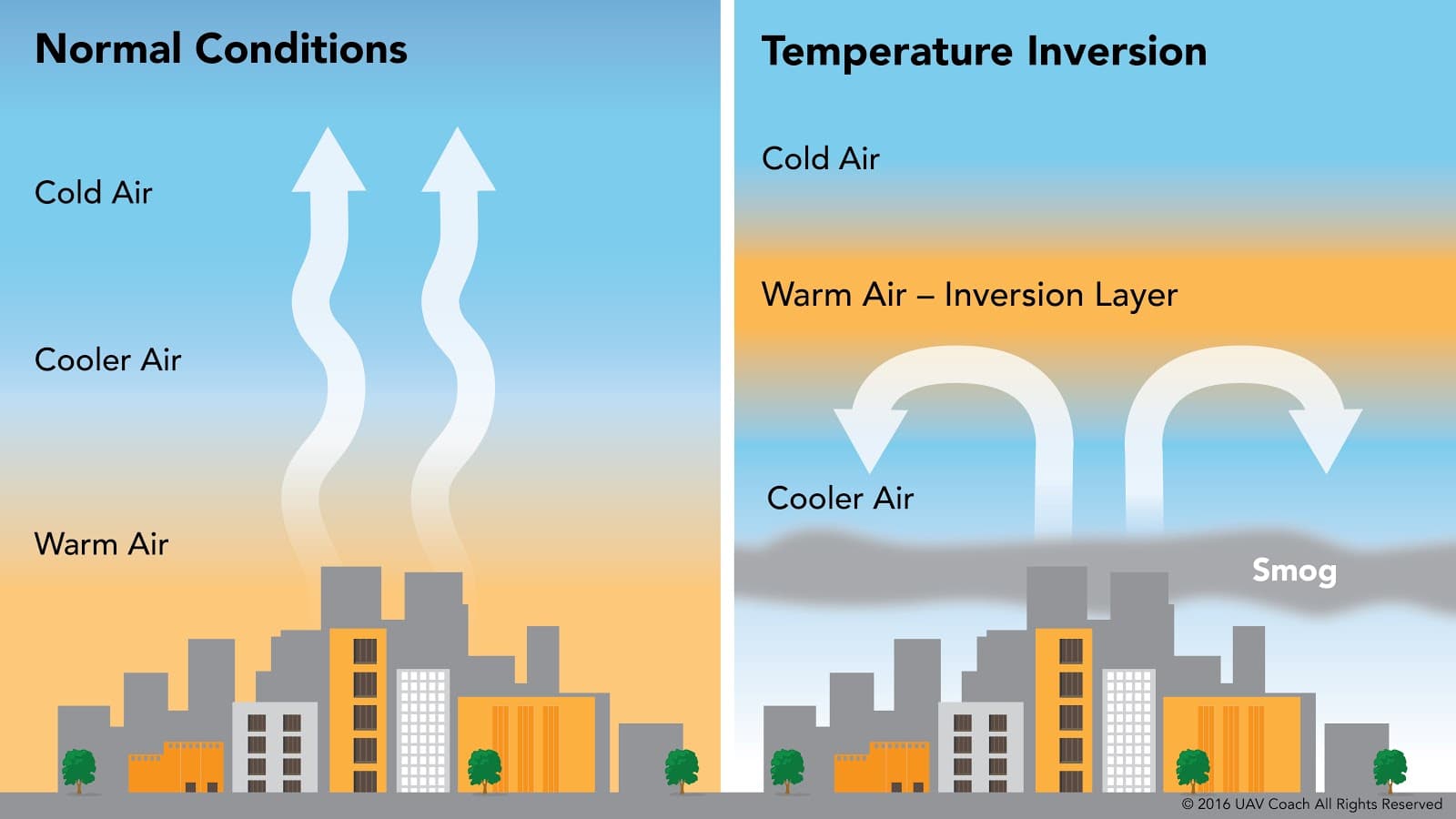
Under normal conditions, the Earth's atmosphere is warmer near the ground and colder at altitude. Since warm air rises, natural convection can carry pollutants away and reduce their concentration.
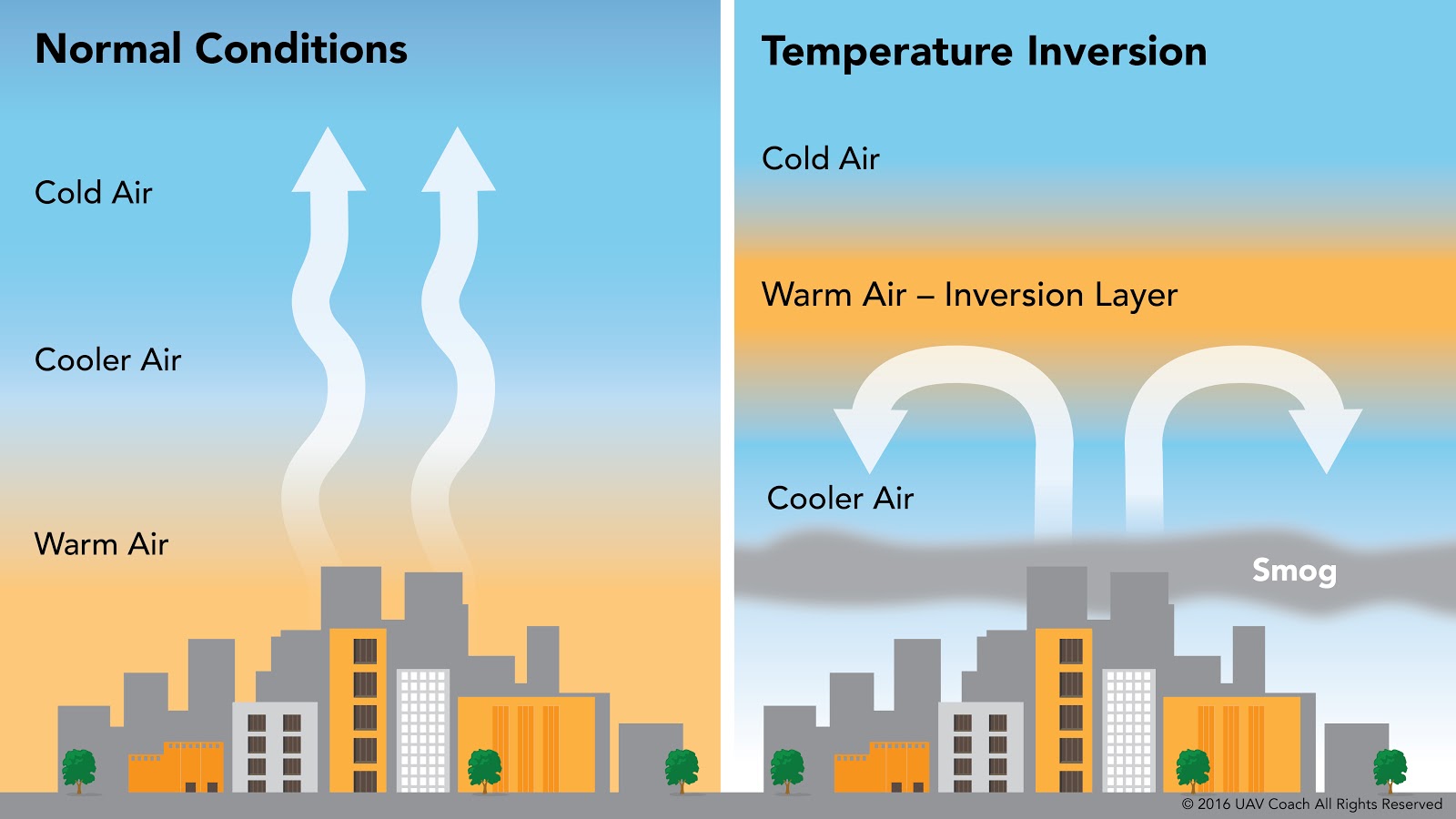
A temperature inversion[4] occurs when the normal temperature variation in the atmosphere is reversed: the air is warmer at altitude and natural convection is blocked, trapping a layer of air near the ground. When this happens over an urban area, pollution can reach particularly high levels because of the large number of emission sources and the lack of air movement.
When a city is covered by a layer of smog that ends abruptly at a specific height, it can be concluded that there is a temperature inversion over the affected area. The smog is trapped because convection cannot carry it above a certain altitude.
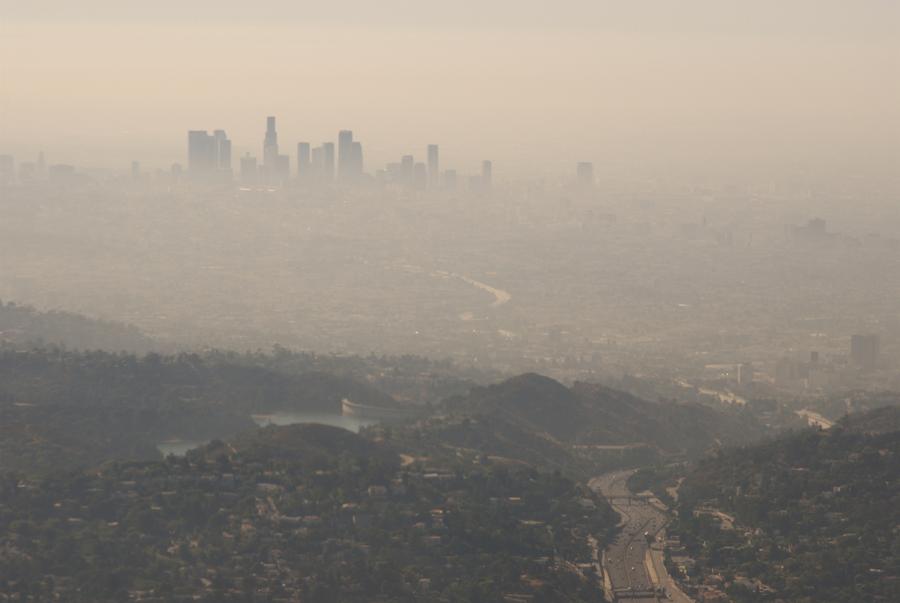
Typical Los Angeles smog. Cities located in valleys (like LA) are particularly affected because the surrounding mountains trap the cool air on the sides, while the warm inversion layer caps it from above.
Temperature inversions can be classified as permanent or temporary. Permanent inversions occur in the upper atmosphere (stratosphere) and have a long-term, global effect on air pollution, while temporary inversions occur in the lower atmosphere (troposphere) and are responsible for the smog layers trapped over urban areas - their effects are short-term and localized.
What concentrations of ozone and fine particulate matter are considered acceptable?
Air quality standards are generally set independently by each country. The World Health Organization (WHO) has established guideline values based on its research, but these are not legally binding unless a country decides to adopt them officially:
| PM | For fine particulate matter, the WHO guideline value is 25 μg/m3 over a 24-hour period, and 10 μg/m3 annually. The US EPA has set 35 μg/m3 (24 hours) and 12 μg/m3 (annually), while the European Commission has set 25 μg/m3 annually and no 24-hour value. | | O3 | In the case of ozone, the WHO sets a guideline value of 50 ppb, which is equivalent to 100 μg/m3. This value has been officially adopted in Canada and Europe, but the US Environmental Protection Agency is less strict, setting the accepted ozone concentration at 70 ppb. |
How to fight ozone and fine particulate matter pollution
To keep the concentrations of ozone and secondary particulate matter under control, it is important to consider that both are the product of chemical reactions involving other pollutants. There will always be hot days with plenty of sunshine, and the weather is impossible to control, but the reactants that lead to the formation of ozone and PM can be regulated: nitrogen oxides (NOx), sulfur oxides (SOx) and volatile organic compounds (VOCs).
Remember, for your health
Particulate matter and ozone have different consequences for human health. PM affects the respiratory and cardiovascular systems and has a carcinogenic effect, while ozone is a gas that irritates the mucous membranes, eyes and lungs.
Spikes also occur at different times of the day. Ozone is driven by sunlight, so it is more concentrated in the afternoon when UV rays are stronger. PM is more present early in the morning and in the late afternoon, when car commuting and residential heating are in full swing.
Trying to control all sources of NOx, SOx and VOCs at the same time would be impractical and extremely expensive, so action must target their main sources, which are motor vehicles, industrial facilities and power plants. The two complementary approaches to follow are monitoring and legally binding regulations.
Recent examples of pollution spikes caused by heat waves
The relationship between high temperature and degraded air quality has been observed in many cases in recent years. For example, India experienced a spike[5] in outdoor ozone concentration in April 2016, reaching 75 ppb (150 μg/m3), 50% above the World Health Organization guideline value. The event came after several days of high temperatures and light winds - heat accelerates ozone formation, while the lack of wind leads to its accumulation.
That same year, the American Lung Association conducted a study on outdoor air quality and found that 166 million US citizens, more than half of the country's population, were exposed to unhealthy levels of ozone and particulate matter[6]. Of the 25 most polluted cities in the United States, seven experienced their highest ozone and PM levels ever recorded, which was linked to rising global temperatures - there was also a high occurrence of droughts and wildfires at the same time.
Conclusion
Air pollution and global warming are a global problem rather than separate issues, and there is a strong interdependence between them. High temperature accelerates the chemical reactions that form pollutants such as ozone and secondary particulate matter, and air pollutants in turn cause more heat to be retained in the atmosphere. Air quality monitoring and enforceable clean air standards play a key role in the fight against air pollution and global warming, and it is important to note that some pollutants are impossible to regulate directly - for example, the concentration of ground-level ozone can be addressed by limiting the emission of the nitrogen oxides and VOCs that lead to its formation.
Sources and references
- [1]Jayamurugan R. et al., "Influence of Temperature, Relative Humidity and Seasonal Variability on Ambient Air Quality in a Coastal Urban Area", International Journal of Atmospheric Sciences, 2013 ↑
- [2]NASA Earth Observatory, "Chemistry in the Sunlight" ↑
- [3]Tibbetts J. H., "Air quality and climate change: a delicate balance", Environmental Health Perspectives, 2015 ↑
- [4]Sciencing, "How Do Temperature Inversions Influence Air Pollution?" ↑
- [5]The Indian Express, "Air quality in Delhi: high temperature spikes ozone, pollution higher than in April ’15", 2016 ↑
- [6]Inside Climate News, article on the American Lung Association "State of the Air" report, April 2016 ↑