Furniture, clothing and many other household products are exposed to harmful chemicals during their manufacturing process. These chemicals can be absorbed by various types of surfaces, especially porous materials, and many are classified as volatile organic compounds, or VOCs. These substances are known to cause irritation and allergic reactions in humans, and have also been linked to more serious health problems after prolonged exposure.
What is off-gassing?
Products that contain VOCs release them through a process called “off-gassing”, and concentrations can rise quickly in enclosed spaces. Two main factors increase the rate at which off-gassing occurs:
- New furniture, clothing and appliances contain a higher concentration of VOCs, since they have not yet had time to release them. As a result, off-gassing tends to be higher in new buildings, after purchasing furniture or after a major renovation.
- Many chemical processes are accelerated at higher temperatures, including off-gassing. According to IAQ sensor data collected in several buildings, the rate of off-gassing increases significantly in summer, when ambient temperatures are higher.
Off-gassing has become a more relevant issue in recent buildings, due to a major shift in construction practices worldwide. Older buildings were designed to have plenty of natural ventilation and a large window area, which limited the build-up of air pollutants; by contrast, recent buildings are designed to be airtight, in order to improve energy efficiency. However, airtightness also creates conditions that favour higher levels of air pollutants, unless the spaces are properly ventilated.
How does temperature affect VOC emissions?
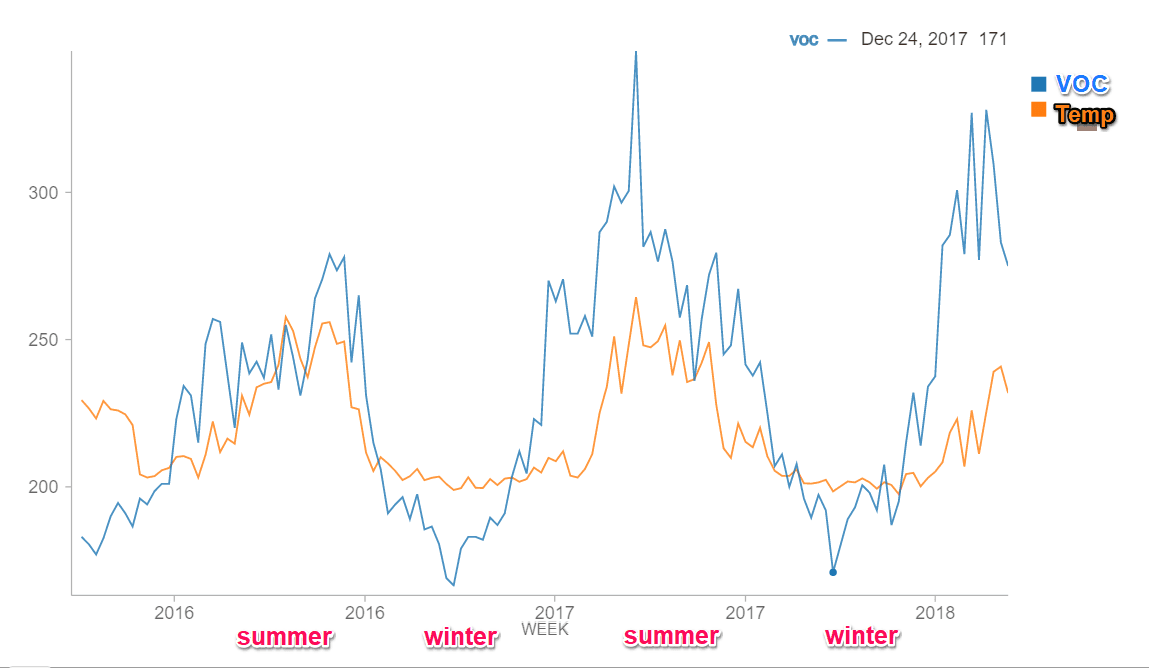
The correlation between indoor VOC emissions and temperature shows clearly in the IAQ sensor data we work with. The readings indicate that VOC concentrations reach their maximum values in summer, when temperatures are at their highest point of the year. The following chart, built from sensor data collected between winter 2015 and summer 2018, illustrates this behaviour:
Note how VOC concentrations fall below 200 ppb in winter, and peak above 300 ppb in summer. This is very relevant information for building owners looking to improve their indoor air quality – for example, if ventilation systems are controlled based on occupancy alone, they cannot respond to the additional VOC pollution present in summer.
Main sources of off-gassing inside buildings
Many objects commonly found indoors emit chemicals into the air, but some sources are known for how quickly they release them. Here are a few of the main examples.
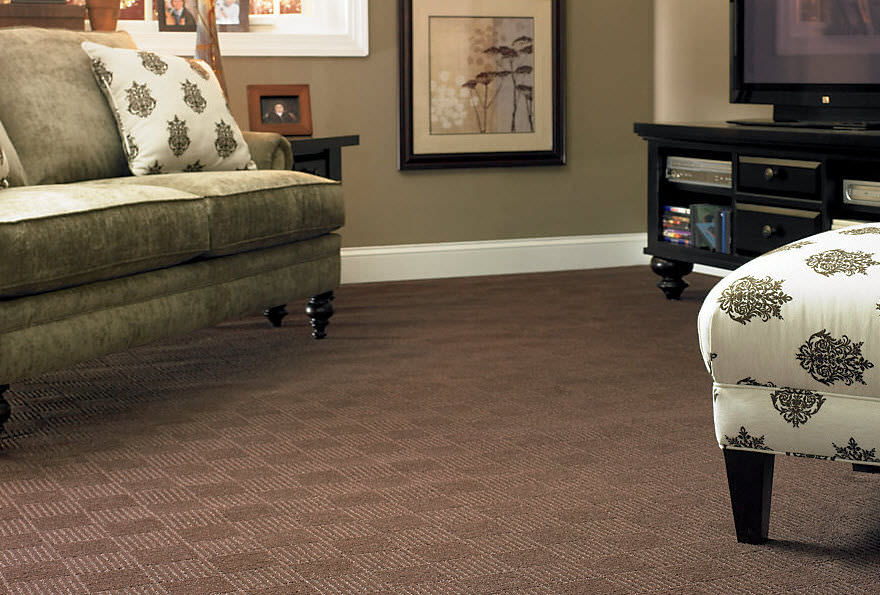
Off-gassing commonly occurs in new products such as wooden furniture or sofas, and in carpeted floors.
- Particleboard or plywood furniture: wood products contain formaldehyde, a VOC that is highly irritating to the eyes and respiratory system, and also a carcinogen. Particleboard and plywood have higher concentrations of this substance due to their porous nature, which means emissions are lower with solid wood products or second-hand furniture that has already had time to off-gas. Note that off-gassing slows down over time – wood products release formaldehyde throughout their entire lifespan, but most of it happens during the first year.
- Glue used with carpeted floors.
- Electronic devices: many components used in electronic devices release VOCs, especially insulating materials with flame retardants. In this case, the release rate is influenced not only by ambient temperature, but also by the heat generated internally when the devices are running.
- Mattresses, carpets and sofas: when you buy a new bed, carpet or sofa, the room where it will be used may need additional ventilation for a while. These furnishings are very porous and contain large amounts of residual VOCs from the manufacturing process.
- Paint: freshly applied paint releases VOCs at a very fast rate. As a result, the off-gassing effect of paint is significant in new buildings, as well as in renovated areas that have recently been repainted. As with wood products, the off-gassing rate slows down over time.
- New homes, with fresh paint and wooden floors, are therefore particularly prone to high VOC concentrations.
How to control the build-up of pollutants caused by off-gassing
As with most air pollutants, there are three main ways to reduce VOC concentrations:
- Remove the source, or minimise emissions if removal is not possible. For example, you can use hardwood furniture rather than particleboard, and specify low-VOC paint for new buildings and renovations.
- Increase ventilation to compensate for the off-gassing rate. To achieve this without wasting energy, you can control ventilation based on VOC readings – running the fans at full power 24/7 is not cost-effective.
- Filter VOCs out of the air. This can be done artificially with air purification systems or your HVAC system, or naturally with plants capable of absorbing VOCs. NASA has published an interesting list of the best plants for controlling air pollution, which we covered in a previous article.
When emissions are controlled at the source or removed by plants, note that there is no energy cost. Ventilation requires electricity, but it is a necessary building system, so responding to air pollutants only adds a small incremental cost. Finally, air purifiers involve additional capital and operating costs, so the recommendation is to use them as a last resort when VOC levels cannot be controlled by other measures.
Update, November 2019. Long-standing claims about the power of plants to improve indoor air quality may be completely wrong, according to a recent study by Drexel University[1]. The researchers explain that the experiments carried out in previous studies were performed in controlled laboratory environments.
According to their findings, in the real world, hundreds of plants would be needed in a single room to approach the air-cleaning capacity of a single air purifier.
While we should remain cautious about the results of this study, it raises reasonable doubts about a widespread belief, and opens an interesting new perspective on the subject.
Why modern ventilation systems are ineffective against off-gassing
Ventilation systems generally have a nominal airflow rate determined by building codes, calculated according to three main factors:
- The main use of the indoor space being analysed.
- The total floor area.
- The expected occupancy.
However, building codes have been slow to address the subject of air pollutants comprehensively. As a result, ventilation systems are normally not designed to respond to VOCs and other common pollutants. A clear example is the design practice used for demand-controlled ventilation, where the airflow rate of a ventilation system is adjusted according to occupancy. However, this design approach ignores two very important facts:
- Occupancy does not always correlate with air pollution. Some activities carried out by few people release large amounts of pollutants; cleaning is a clear example, where many indoor surfaces are exposed to chemicals with a high VOC content.
- Pollutants can be released when there are no occupants at all, and off-gassing is one example.
To guarantee indoor air quality (IAQ), ventilation systems must be able to respond directly to pollutant concentrations. This is only possible if the ventilation controls are fed with air pollution data, which can only be collected with a reliable air monitoring system.
Volatile organic compounds can be very misleading, since many of them actually have pleasant smells. As a result, human senses are not reliable for assessing air pollution. The smell of a new car is a clear example – many people enjoy that smell, but it is caused by harmful VOCs released by recently manufactured components.
How to speed up off-gassing
When you get into a new car, it has a strong, distinctive smell: this is due to the high rate of VOC emissions. Over time, the smell will fade and you will eventually breathe clean air.
The same goes for a new flat or house. But since you spend a lot of time at home, you may want to speed up the off-gassing process. Here are a few methods:
- Ventilate, either with your HVAC system or by opening windows, using fans, and so on.
- Heat. Since the off-gassing rate increases with temperature, some heating can help.
- Let a new product air out before using it. This is not easy, especially for a sofa or a mattress. There is no specific duration, but the longer the better.
Conclusion
Off-gassing is a source of VOCs that can easily go unnoticed, since it is not associated with occupancy or any particular indoor activity. There is evidence that off-gassing increases at higher temperatures, and it is a bigger issue in recently built or renovated spaces. Products such as furniture and electronic devices are also known for their higher emission rates when new.
To control the build-up of air pollutants, you need a ventilation system that responds to them, and this concept is only viable if IAQ sensors report the pollutant concentrations in indoor air. This is exactly where Foobot comes in: not as a monitor, but as an AI technology that uses the building's IAQ sensor data (VOCs, CO2, particulates) to control the air renewal equipment, air handling units (AHUs) and rooftop units (RTUs), through the building management system. Fresh air then follows the actual pollutant levels and occupancy rather than a fixed schedule: more when VOCs rise, less when the space is empty.