What is a smart building?
Definition of a smart building
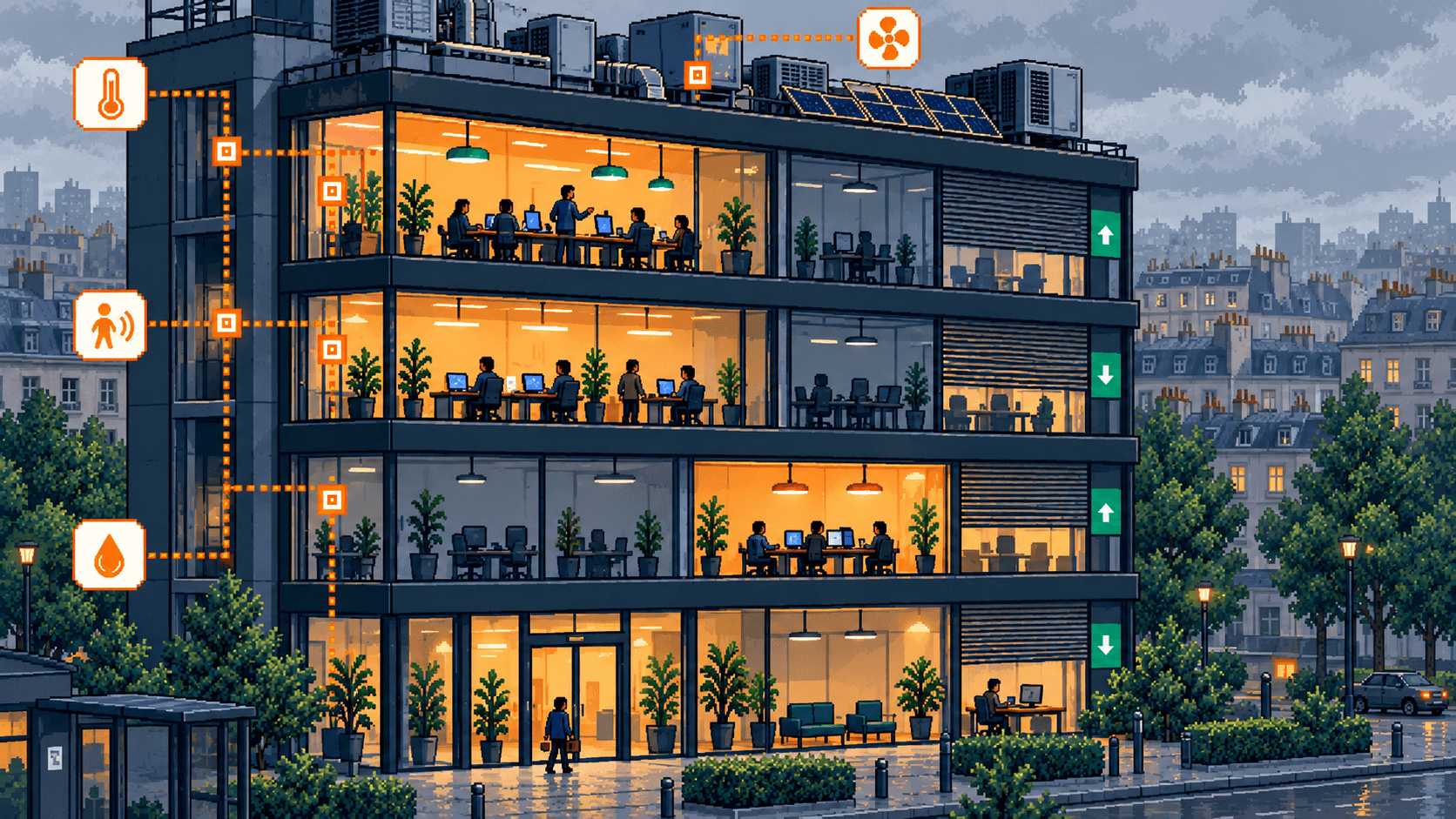
A smart building is a building that integrates advanced systems and technologies to optimize energy management, energy consumption and occupant comfort. Using sensors, automation systems and real-time data, it adapts to what its users need and improves energy performance while cutting costs.
Why it matters today
At a time when demand for sustainable solutions and lower energy consumption are both critical, smart buildings play a key role in the future of cities. They make real estate assets more attractive and more valuable by adapting to modern ways of working. In an office building, for example, spaces have to adapt to a fluctuating number of occupants. With solutions such as smart workplaces, an intelligent system makes sure every employee finds a free desk, while optimizing the use of space.
Key features of smart buildings
The underlying technologies
Smart buildings rely on technologies such as the Internet of Things (IoT), sensors, and automation systems. Together they allow fine-grained energy management, controlling key equipment such as heating, ventilation, lighting and temperature according to what occupants actually need.
What can smart buildings specifically do?
Smart buildings offer a wide range of essential capabilities:
- Optimized energy management to cut consumption.
- Stronger security systems, including access control through automatic doors and site surveillance.
- Better comfort, with automatic control of temperature, ventilation and lighting.
- Real-time performance monitoring based on data collected by sensors.
Scalability and integration
Smart buildings fit seamlessly into wider networks such as smart cities. By automating heating, ventilation and air conditioning (HVAC) systems, they can manage energy consumption around demand peaks. Artificial intelligence, for instance, can forecast requirements and adjust energy use so the electricity grid is not overloaded. That not only improves energy efficiency, it also generates savings for the building manager.
Worth knowing: Smart buildings also help reduce the carbon footprint of the real estate sector, with energy savings of up to 20%. By bringing in artificial intelligence, they analyse data in real time to optimize systems and improve air quality. That supports occupant comfort and can also increase productivity in the workplace.
The benefits of smart buildings
For occupants
Smart buildings significantly improve occupant comfort through optimized heating, ventilation and lighting systems. They also deliver better security through state-of-the-art technology, while improving day-to-day quality of life.
For managers and owners
For managers and owners, smart buildings offer major benefits, chief among them lower operating costs and better resource management. By optimizing energy consumption, these buildings cut energy-related spending while improving the overall performance of the asset.
Environmental impact
Environmental impact is another key factor. Through more efficient energy management and lower resource requirements, smart buildings help cut carbon footprints while aligning their performance with environmental sustainability targets.
Challenges and considerations for implementation
Implementation costs
Smart buildings deliver many benefits, but the up-front costs can be high, particularly for installing advanced equipment and systems. Those costs can, however, be paid back quickly through savings on energy consumption and operating expenses.
Technical complexity
Technical complexity is another major challenge. The technologies used in these buildings have to be interoperable, meaning that different generations of systems and equipment must be able to talk to each other. It is essential to choose solutions with long-term support, to avoid the kind of problems seen with some LON controllers, for which repair and support have since disappeared.
Training and skills required
Smart buildings need trained staff to run the new technologies. That means growing training requirements for building managers and technicians, so systems can be managed effectively and sustainably.
Worth knowing : implementing smart buildings can also qualify for tax incentives and government subsidies designed to promote energy efficiency and sustainability. Those schemes can offset the up-front costs and make adoption more accessible. On top of that, the fast pace of technological change creates opportunities to bring in even more advanced solutions as they become available, strengthening the long-term value of the investment.
Real-world examples of smart buildings
Successful case studies
Examples of smart buildings can be found in projects around the world, where properties have adopted advanced solutions to optimize energy management while improving occupant comfort and safety. Take the headquarters of Bouygues Immobilier:
The Bouygues Immobilier headquarters, named Green Office ENJOY, is a striking example of a smart, sustainable building, located in Paris Batignolles. Covering 17,400 m², this energy-positive building produces 23.5 kWhPE/m²/year of renewable energy against a consumption of 22.9 kWhPE/m²/year, a surplus of 2.6%.
Its innovative hybrid timber-and-concrete structure, with 2,700 m³ of timber across 5 of its 7 floors, saves 2,900 tonnes of carbon, the equivalent of planting 1,500 trees. The building has 1,700 photovoltaic panels and is connected to the district heating network of the development zone, optimizing its energy performance. Certified BBCA (low-carbon building), Green Office ENJOY is part of the Bouygues Immobilier strategy to cut greenhouse gas emissions by 30% by 2030.
The project shows that it is possible to build large-scale properties that are both energy-efficient and environmentally sound, in line with Paris's carbon neutrality targets for 2050.
Innovations and emerging trends
Innovation continues to transform the smart building sector, with emerging trends such as greater automation, intelligent energy control, and carbon reporting solutions. These technologies promise to improve the performance and efficiency of buildings further still.
Fitting into the smart city concept
Interaction with other urban systems
Smart buildings do not operate in isolation: they fit into wider urban networks, interacting with smart city infrastructure. That includes managing energy resources and transport systems, allowing optimization at the scale of an entire city.
Smart buildings can interact with urban transport systems, for example:
- They can provide real-time information about nearby public transport.
- Some buildings have electric vehicle charging points connected to the city's electric mobility network.
Their role in urban sustainability
Because they cut energy consumption and optimize the use of resources, smart buildings contribute directly to the sustainability of cities, supporting more resilient and environmentally sound practices.
The outlook for smart buildings
Technology developments ahead
Smart building technology continues to evolve, with innovation in intelligent control of energy consumption and in peak load shedding to ease demand on the grid. These developments will help meet the requirements of regulations such as the Décret tertiaire (France's energy reduction mandate for commercial buildings), which imposes significant cuts in energy consumption by 2050.
The impact of regulations and standards
Regulatory change, such as the BACS decree and the Décret tertiaire, sets ambitious targets for cutting energy consumption in buildings. The Décret tertiaire in particular requires a 40% cut in energy consumption by 2030, 50% by 2040, and 60% by 2050. These regulations establish a floor for what energy control in buildings must be capable of.
The best-performing buildings, however, go well beyond those standards, continuously improving their efficiency and performance to meet, and even exceed, those long-term sustainability targets.
Conclusion: the future of smart buildings
Adopting smart buildings is essential to a sustainable future. By optimizing energy consumption, improving occupant comfort and reducing environmental impact, they are a fitting answer to today's challenges. It is time for companies and building managers to take the steps needed to bring these technologies into their management strategies.
Back to blog